
Borobudur: a path through the stone, reliefs, and silence of an ancient temple
Borobudur is not just an ancient temple, but an architectural journey that gradually leads upward: from stone reliefs and galleries to stupas, the open sky and the panorama of Central Java.
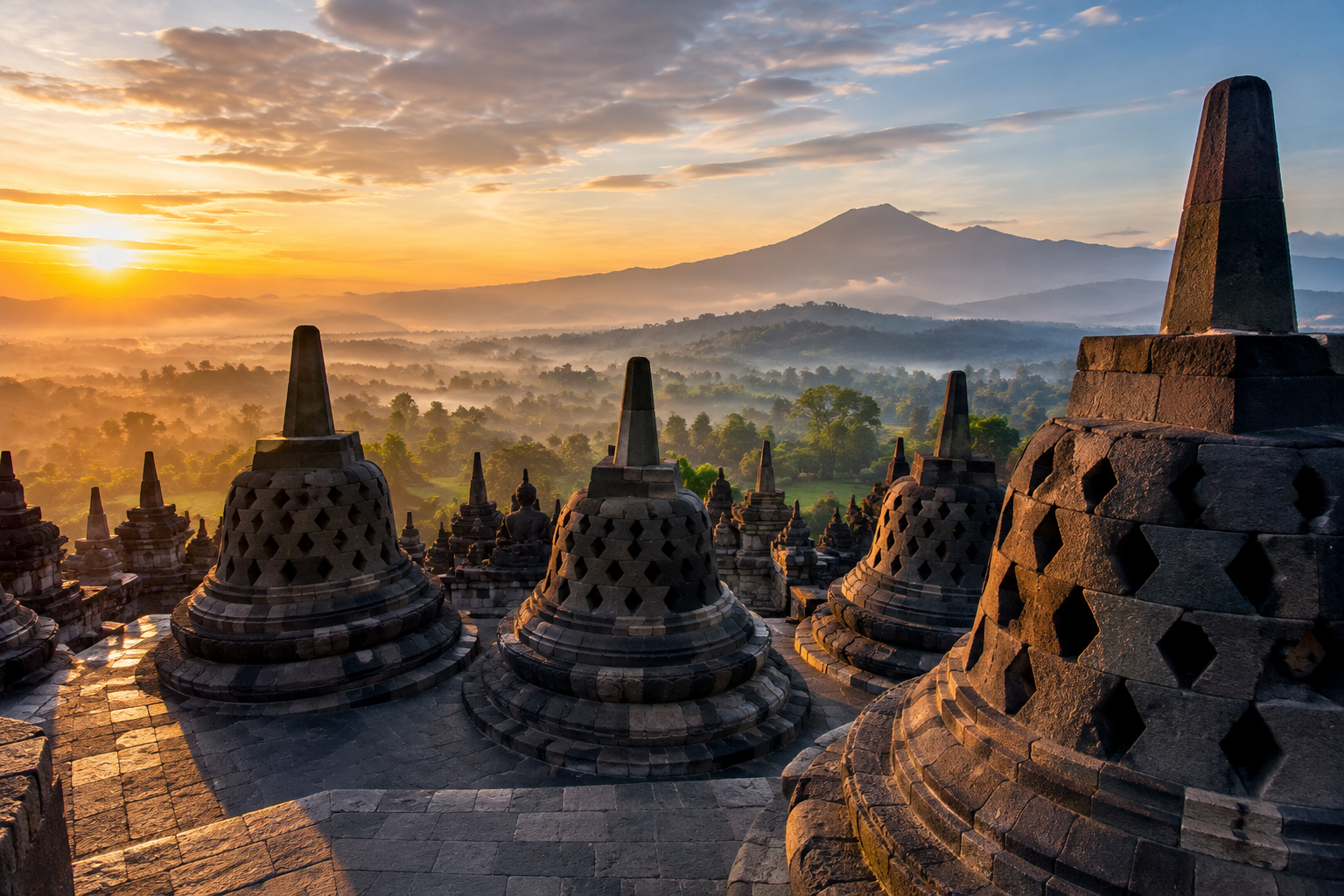
It's best not to approach Borobudur as an ordinary tourist attraction.
It is difficult to understand him at a glance.
First you see a huge stone mass.
Then you start to notice levels.
Galleries.
Reliefs.
Stairs.
Stupas.
And only after this does it become clear that the entire temple is structured as a movement.
From bottom to top.
From details to space.
From dense stone to open sky.
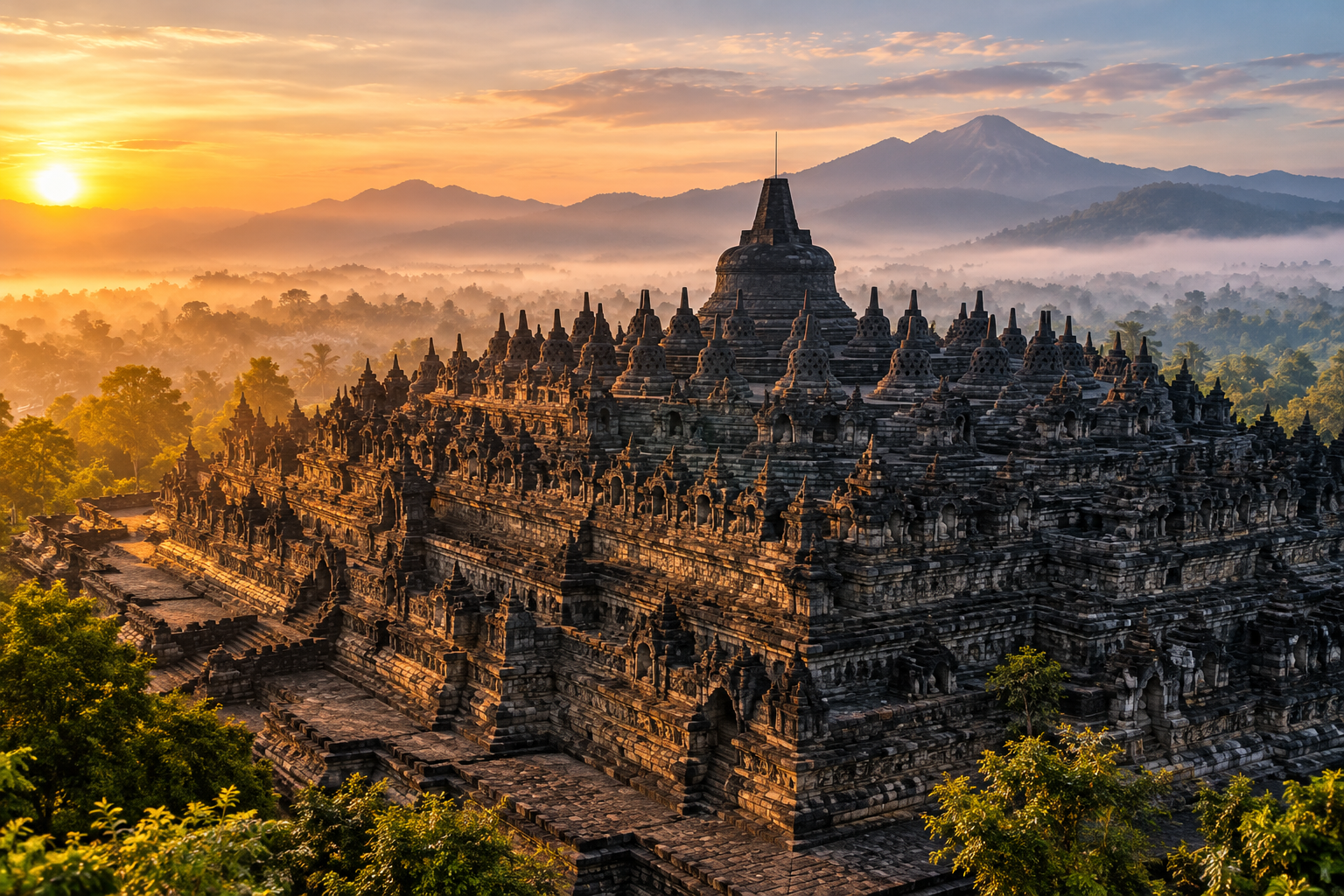
At dawn, Borobudur appears particularly complete: the stone levels still lie in soft shadow, and the surrounding landscape gradually emerges from the morning haze.
First look
It is difficult to get a sense of the size of Borobudur from a photograph.
In photographs it often looks more compact than in reality.
But as you get closer, the scale begins to reveal itself.
The base appears massive.
The stairs are longer than you expect.
And the levels go up one after another.
The temple is not built as one large interior space.
There is no central hall to enter.
Instead, the journey takes place outside, through circular galleries and passages.
And that is why Borobudur is perceived not as a building, but as a path.
The stone that tells
One of the greatest strengths of Borobudur is its relief.
It's easy to go through them too quickly.
This is a mistake.
The stone panels here do more than just decorate the walls.
They form a long visual story.
Figures of people.
Animals.
Palaces.
Boats.
Cities.
Scenes of everyday life.
Religious stories.
The longer you look, the more you get the feeling that you are not looking at a decoration, but at a huge stone book.
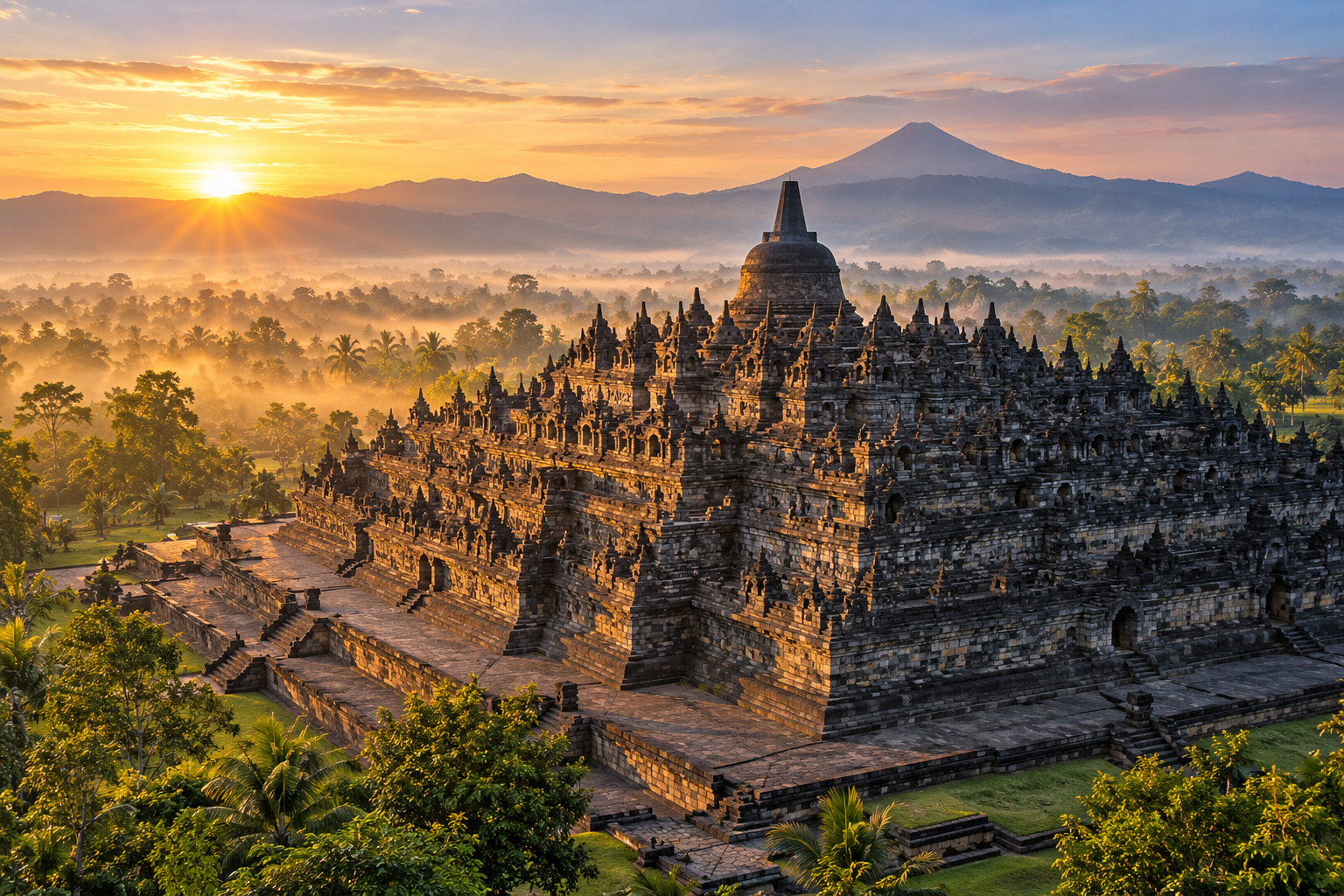
The reliefs of Borobudur read almost like pages: each scene continues the previous one, and the stone preserves details of the life, beliefs, and ideas of the era.
Don't rush up
Most people instinctively want to get to the top as quickly as possible.
Where the famous stupas are located and the panorama opens up.
But if you go through the lower levels too quickly, much of Borobudur will go unnoticed.
It's better to go gradually.
Browse the gallery.
Look at the reliefs.
Change direction.
Take it to the next level.
And go around the circle again.
Thus, the temple begins to function as it was architecturally intended.
The gradual upward movement changes not only the height.
The very sense of space changes.
Stairs and passages
The transition between levels always feels a little different.
Below, the space is more closed.
The walls are higher.
The corridors are denser.
There is more air at the top.
More light.
The horizon begins to appear between the stone forms.
This transition is especially noticeable in the morning, when the sun gradually rises and the shadows inside the galleries become shorter.
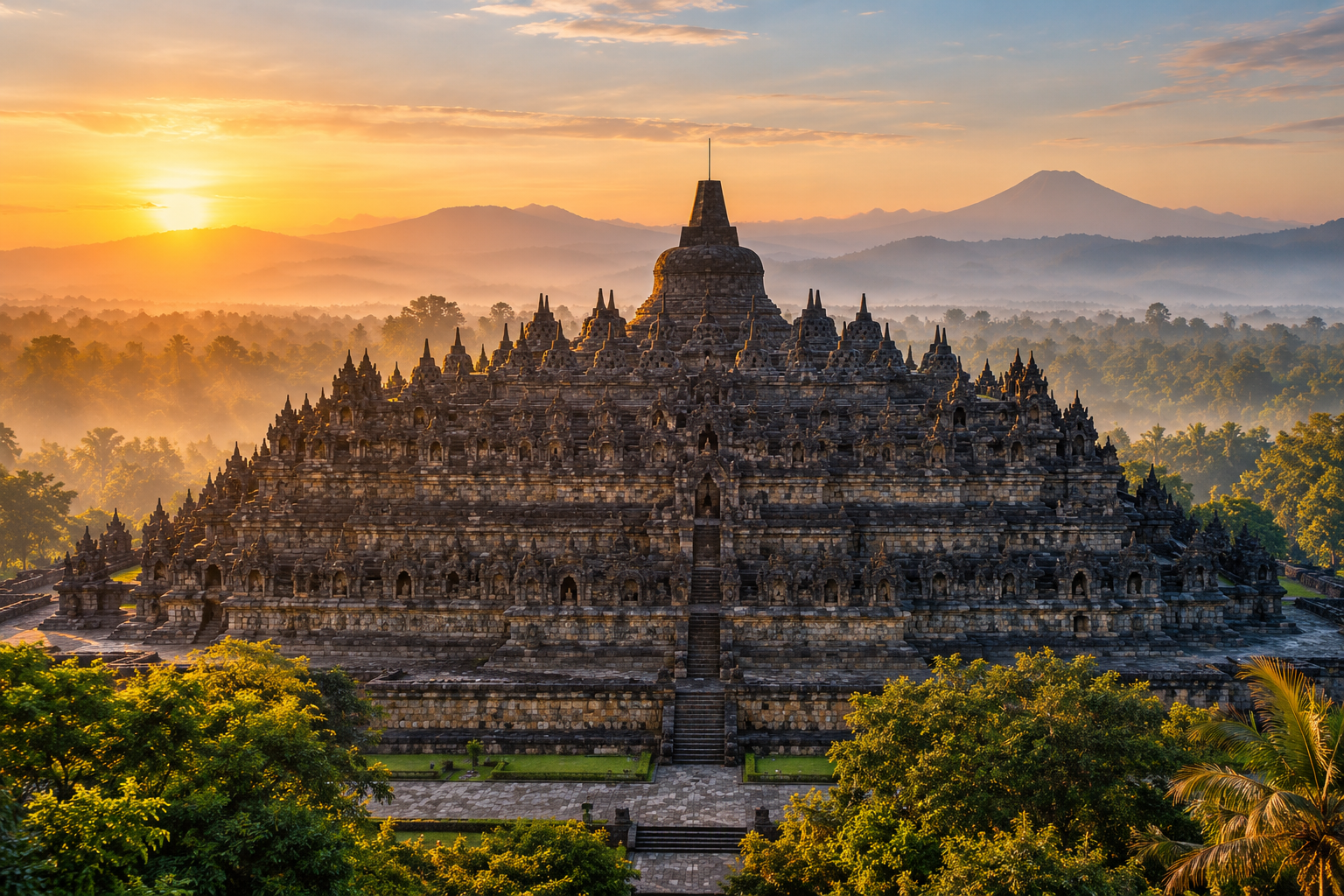
The staircases of Borobudur connect not only architectural levels, but also different sensations: below, the space is dense and enclosed, while above, there is increasing airiness and light.
Upper terraces
At the upper levels, the character of the temple changes almost completely.
The walls disappear.
Instead of long galleries, round terraces appear.
There are stupas on them.
Each has a characteristic stone lattice.
Some of them contain images of Buddha inside.
There is no longer any desire to look for small details here.
The main thing becomes space.
Sky.
The rhythm of repeating steps.
And the landscape around.
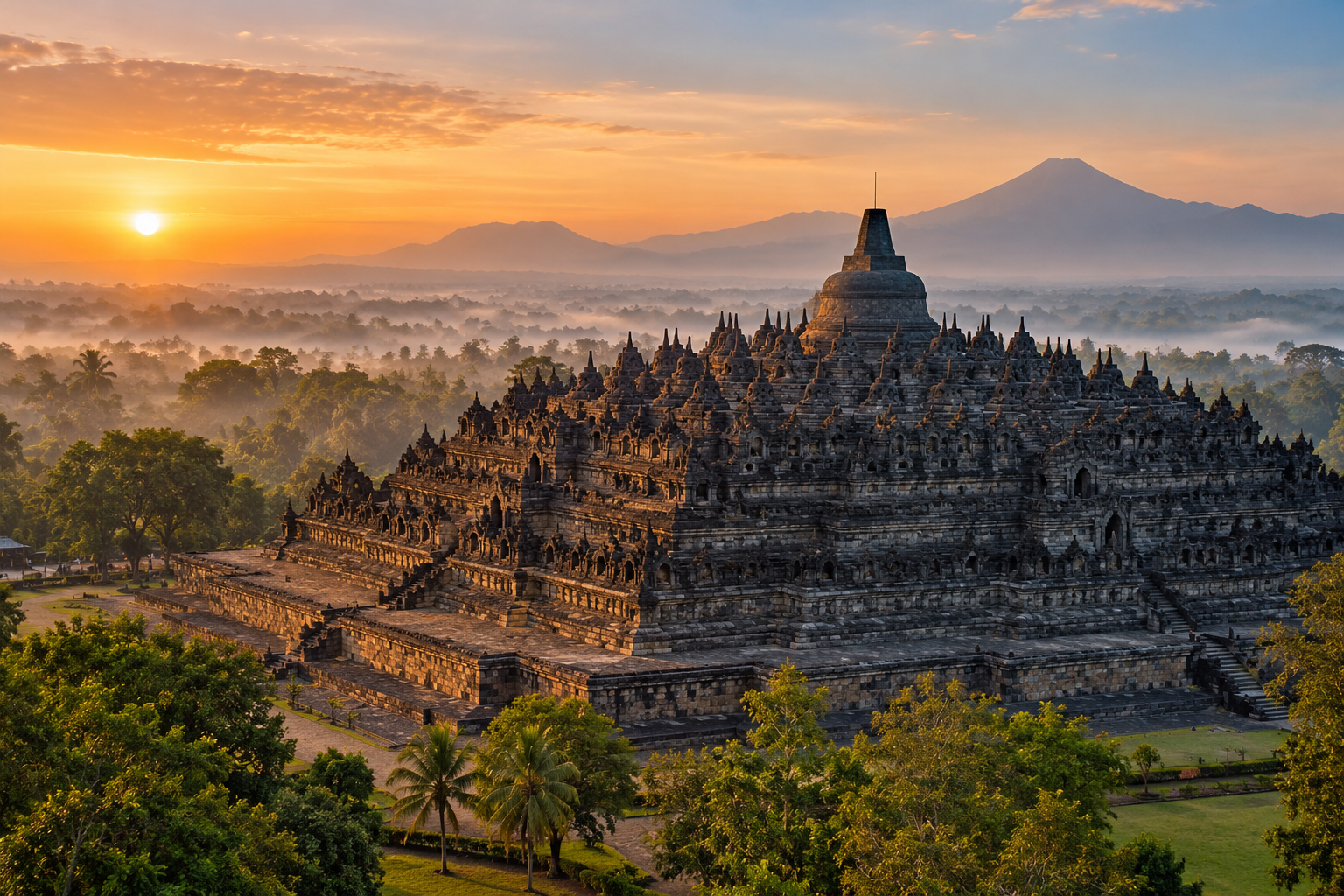
At the top, Borobudur becomes almost geometric: circles of terraces, repeating stupas and distant mountains create a sense of order and silence.
Light changes the temple
Borobudur is highly dependent on the time of day.
On a bright day, the stone looks hard and graphic.
In the morning - softer.
After the rain it's darker.
In cloudy weather the reliefs become more contrasting.
And during fog, the upper part of the temple may seem almost separated from the ground.
Therefore, there is no one “correct” Borobudur.
Every light shows it differently.
Panorama of Central Java
From the top, you can clearly see how the temple is connected to the surrounding landscape.
Mountains.
Green fields.
Palm trees.
Villages.
Sometimes - a light haze.
Borobudur is not located in the middle of a dense city.
And this is precisely what enhances the impression.
After a long climb, the gaze finally goes beyond the stone and goes to the horizon.
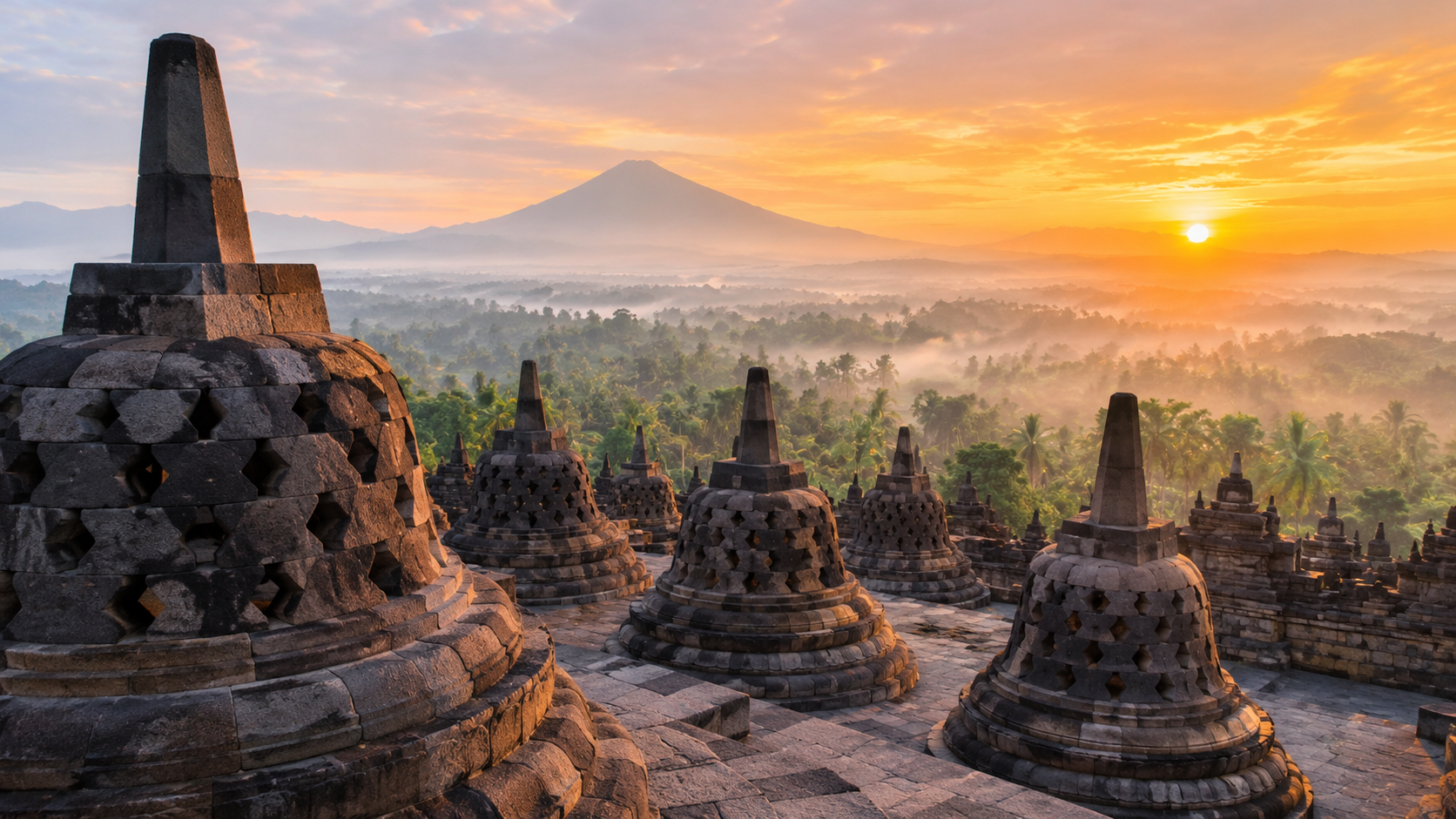
From the upper terrace, the temple ceases to be a separate object; it becomes part of the larger landscape of Central Java.
Why it's best to come here without rushing
Borobudur can easily be turned into a short stop.
Come.
Rise up.
Take photos.
Leave.
But this format almost always leaves only a superficial impression.
It is better to give the temple more time.
Even if part of this time is spent simply on a slow walk.
For one relief.
Apparently between the stupas.
For a few minutes of silence.
It is precisely these moments that are often remembered more vividly than the general panorama.
Modern visiting rules
Borobudur is a historical monument and access rules are subject to change.
The number of visitors on certain levels may be limited.
Sometimes there are separate tickets or time slots available.
Therefore, it is important to check the current conditions before traveling.
You shouldn't expect that the previous visiting rules will remain unchanged.
This is especially important if the main goal is to rise to the upper levels.
Clothing and behavior
This is not just a tourist site.
Borobudur remains a religious and cultural monument.
Clothing should be respectful and comfortable.
Shoes - suitable for stone stairs.
You should not climb where it is prohibited or use ancient elements as a prop for photography.
The best attitude to take in a place like this is to slow down a bit.
After the rain
Borobudur has another mood.
After a tropical rain the stone becomes almost black.
Water remains in the depressions.
The air is getting cooler.
The vegetation around looks brighter.
And sometimes there are fewer tourists.
At such moments the temple seems especially ancient.
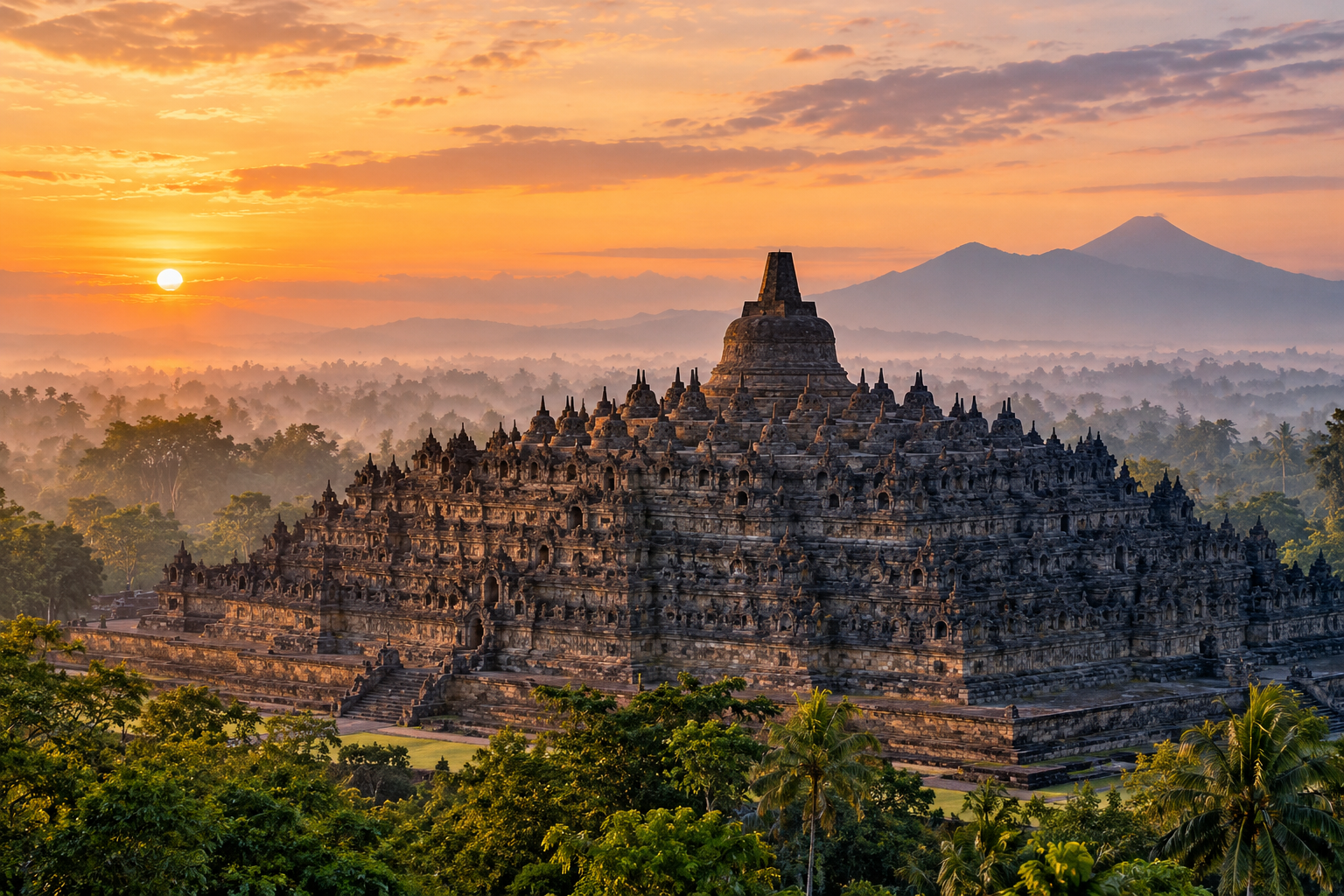
After the rain, Borobudur changes completely: the stone becomes dark, the greenery around it becomes brighter, and a light haze makes the temple almost timeless.
Not just photography
Borobudur is easily recognizable from just one photo of the stupas.
But this is only the tip of the story.
The real experience starts below.
In reliefs.
In long galleries.
In the stairs.
In gradual ascent.
And in that moment when, after a dense stone space, a huge sky suddenly opens up.
This is why Borobudur is remembered not just as one beautiful shot.
It is remembered as a movement.
Step by step.
Level by level.
From the stone to the horizon.
Comments
Share your thoughts