
Bromo before dawn: a journey to the volcano amid fog and a sea of sand
The journey to Bromo begins at night: cold mountain air, a jeep ride, the first rays of light over the volcanoes, and a vast sea of sand. This is a route where the anticipation of sunrise becomes as much a part of the experience as the volcano itself.
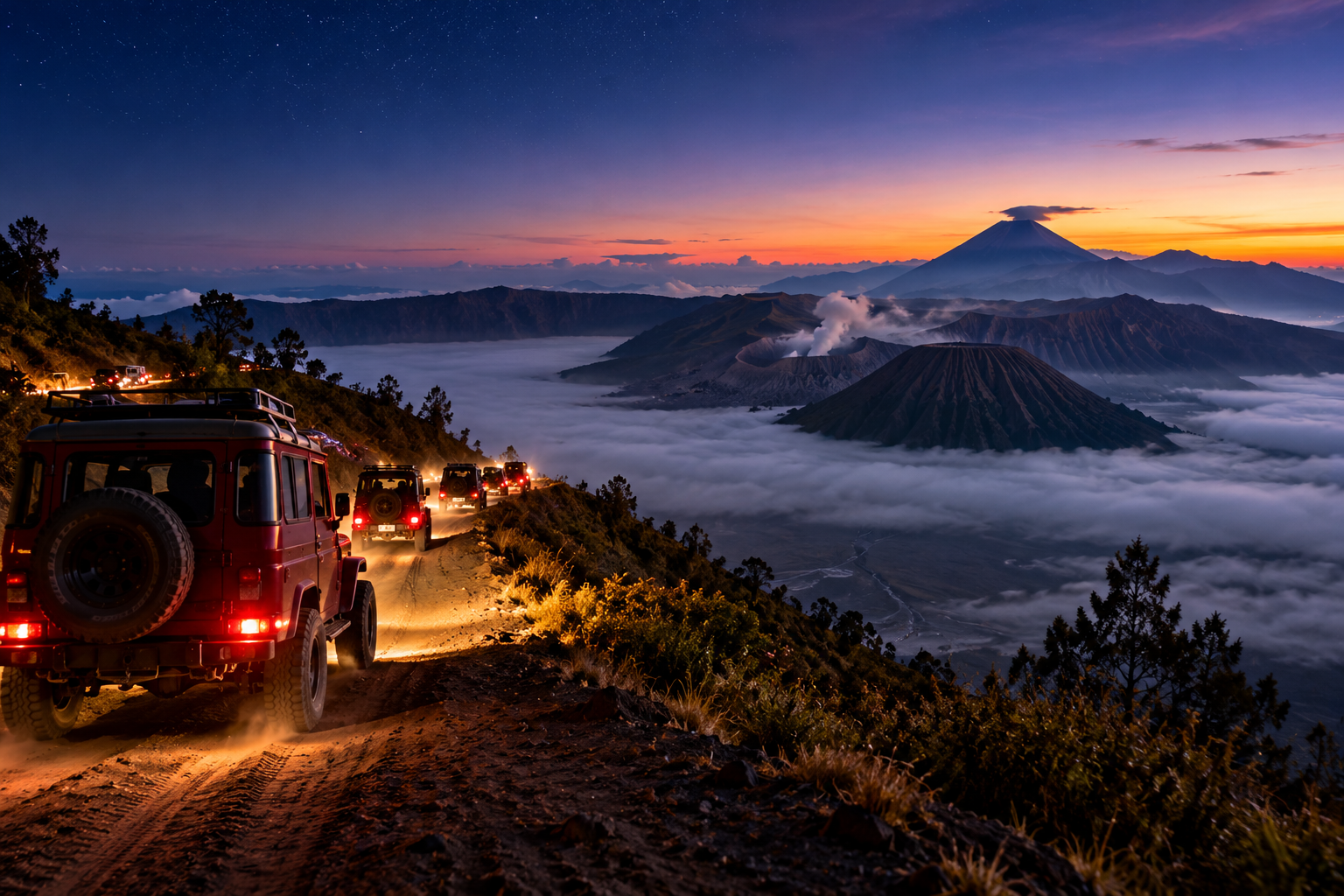
At three o'clock in the morning Bromo is almost impossible to see.
Instead of the famous volcano, before my eyes there is a dark road, rare lights, silhouettes of jeeps and people wrapped in jackets.
It seems strange to get up in the middle of the night for a landscape that doesn't even exist yet.
But this is where the journey begins.
The engine starts.
The headlights snatch the turns from the darkness.
The road gradually rises higher.
And somewhere ahead, behind the mountains, in a few hours light will appear.
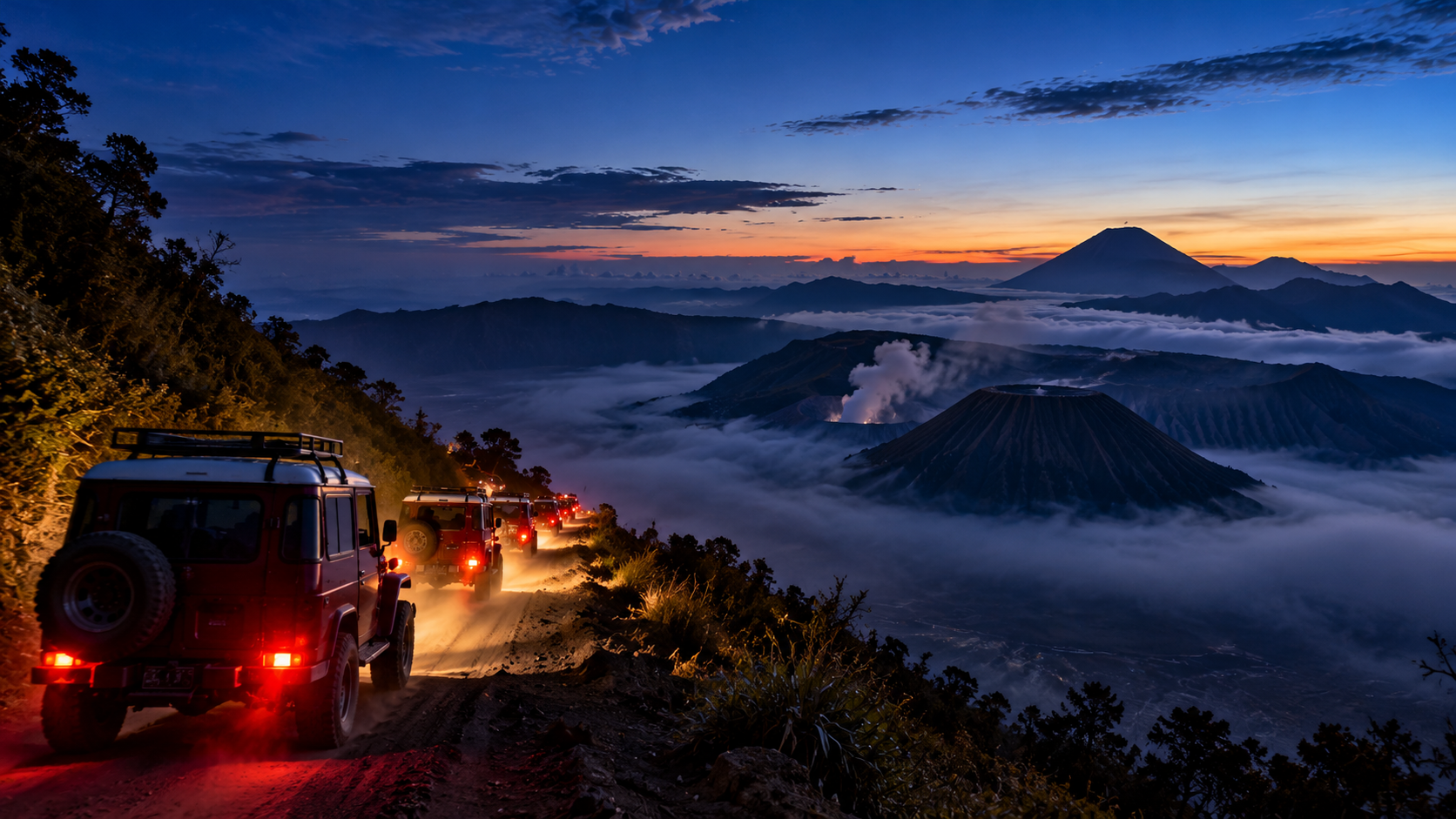
The journey to Bromo begins long before sunrise: in the darkness, all that is visible are the headlights of jeeps, the cold air, and the barely discernible silhouettes of the mountains.
Before dawn
The highlands of East Java at night are completely different from the tropical Indonesia we are used to.
It's cold here.
Sometimes so much so that the first thought is why no one warned me to take another layer of clothing.
People get out of their cars, buy hot tea or coffee and slowly walk to the observation decks.
There is almost nothing visible around.
There is only sky, silence and anticipation.
Gradually the black horizon begins to turn blue.
Then a thin strip of light appears.
A few more minutes and the outlines of the volcanoes become visible.
Bromo does not appear immediately.
At first the entire scene is visible.
Mount Semeru in the distance.
Cones around the caldera.
Fog lying below.
And little Bromo, from whose crater thin smoke sometimes rises.
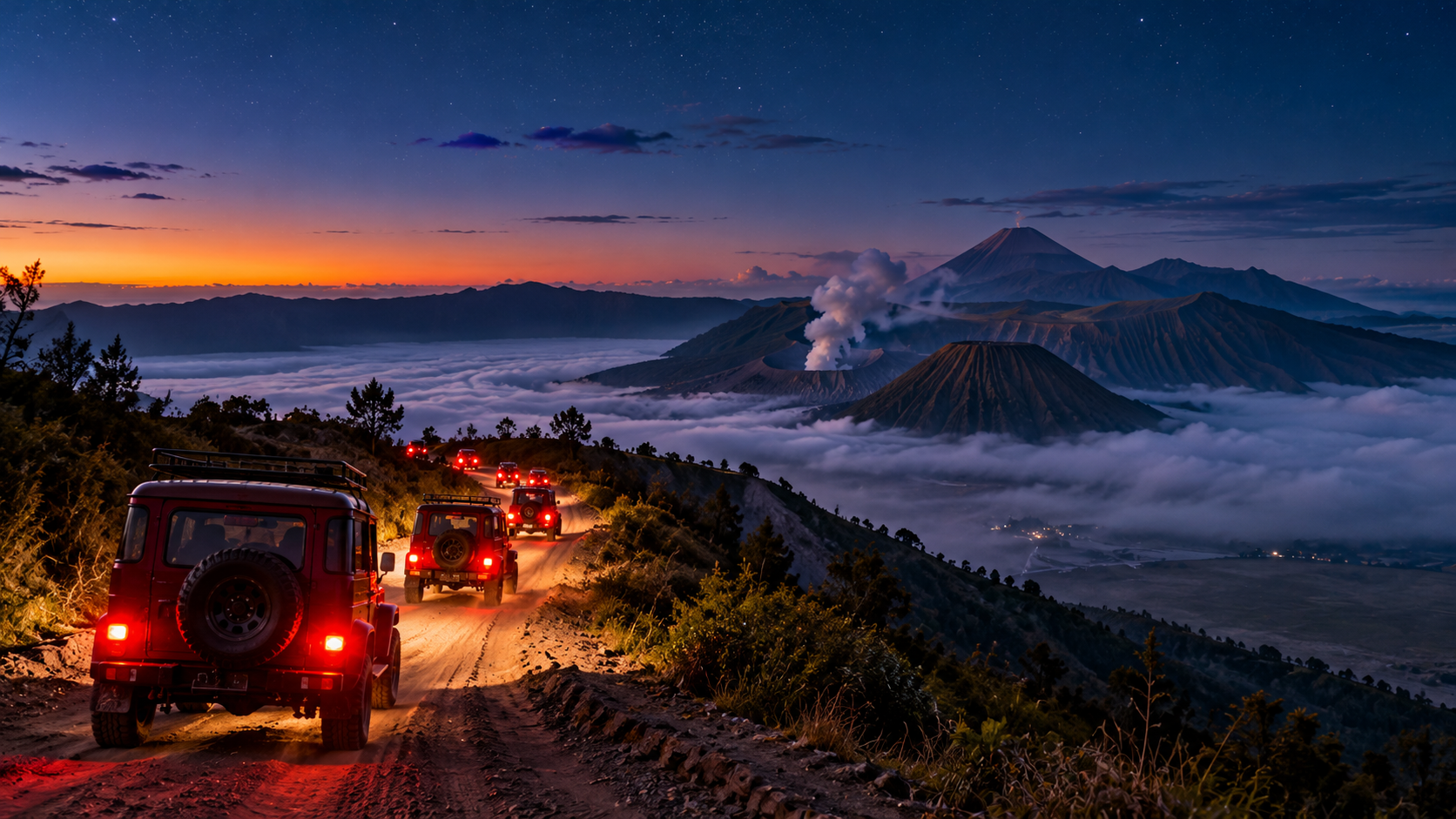
Before sunrise, the volcanoes appear as almost flat silhouettes, but the first rays gradually reveal the caldera, smoking Bromo and Semera in the background.
A few minutes that people come here for
There is no one fixed colour to the dawn over Bromo.
Every morning looks different.
Sometimes the sky turns golden.
Sometimes - pink and cold.
Sometimes clouds cover the horizon and the sun appears much later than expected.
But even without a perfect sunrise, the scale of the landscape is impressive.
The main thing here is not the sun itself.
The main thing is the moment when it becomes clear where you are.
At night the surrounding space seems small.
As the light comes in, it becomes clear that you are looking at a huge volcanic caldera.
And only then does the thought occur: the next stage of the route passes right along its bottom.
Down to the Sea of Sand
After dawn, the jeeps begin to descend.
The road suddenly changes character.
Instead of a mountain serpentine, a wide open space appears.
This is the Sea of Sand, a plain within the caldera surrounding Bromo.
From a distance it appears almost smooth.
Nearby, the surface consists of volcanic sand and dust, which rise in the wake of the cars.
The jeeps scatter in different directions.
Some stop in the middle of the plain.
Others continue moving almost to the foot of the volcano.
The landscape looks unexpectedly empty.
There is no dense forest.
There are no cities.
There is no usual green Java.
Only sand, volcanoes and a huge sky.
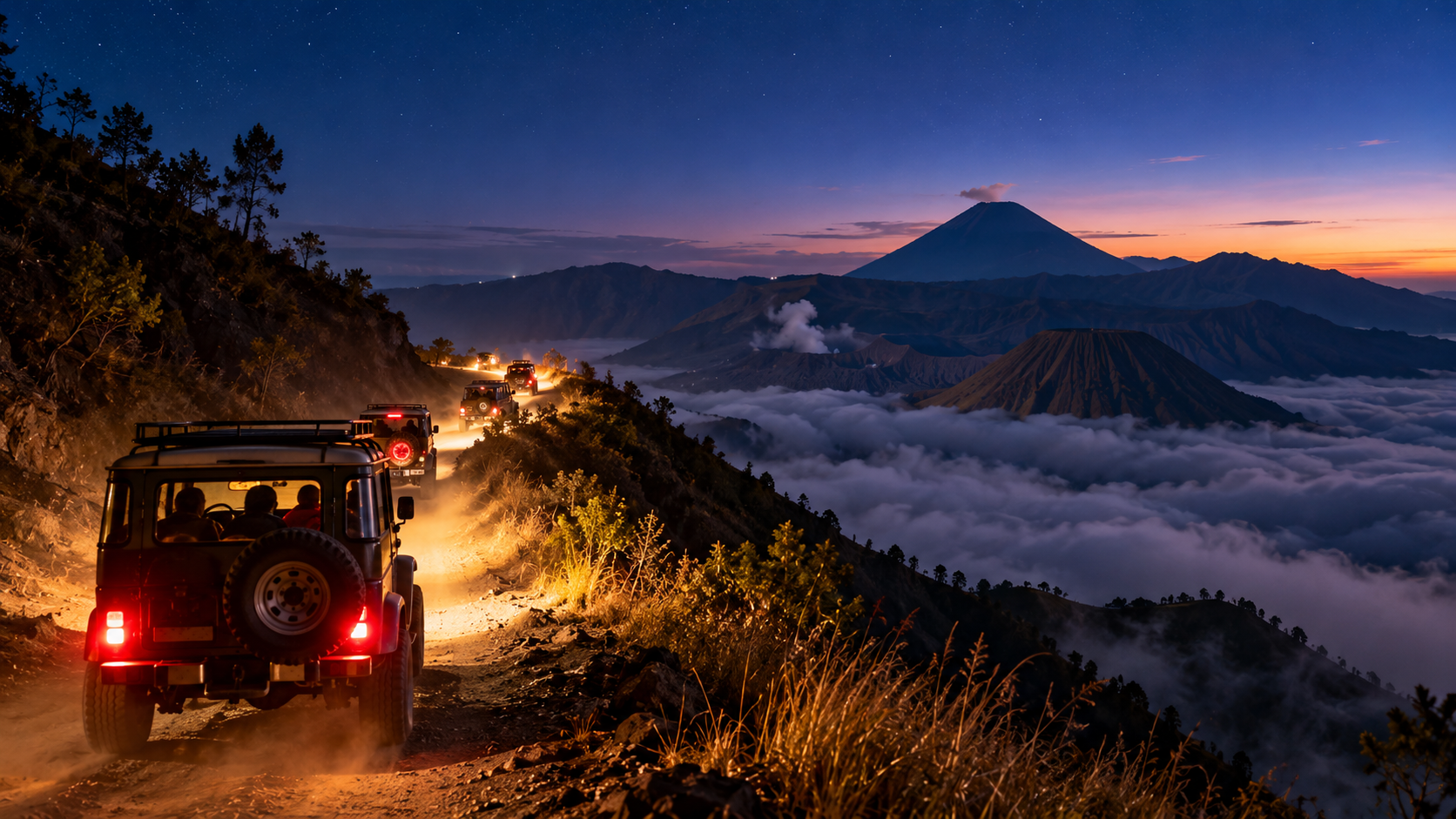
At the bottom of the caldera, the scale becomes especially noticeable: the jeep seems like a tiny dot against the backdrop of volcanoes and an almost endless sandy plain.
The last part of the journey is on foot.
It is not possible to reach the crater itself by car.
The last section has to be covered on foot.
At first the road goes through open space.
Then the climb begins.
At altitude, breathing becomes heavier, and volcanic dust quickly reminds you that the route is not a typical tourist trail.
The higher you climb, the more you feel the proximity of the crater.
A sulfur smell appears.
Sometimes a low hum can be heard.
And finally, the edge of the volcano appears before our eyes.
On the edge of the crater
Bromo doesn't look like a perfectly symmetrical textbook volcano.
Its crater is rough, grey and alive.
A dark depth is visible inside.
Steam and smoke may rise from the holes.
Standing at the top, it's easy to forget that just a few hours ago, this same volcano looked like a small part of a huge panorama from the observation deck.
Now it takes up the entire field of vision.
This is one of the most interesting contrasts of the route.
At first you see Bromo from afar.
Then you cross its caldera.
And then you find yourself literally on the edge of the crater.
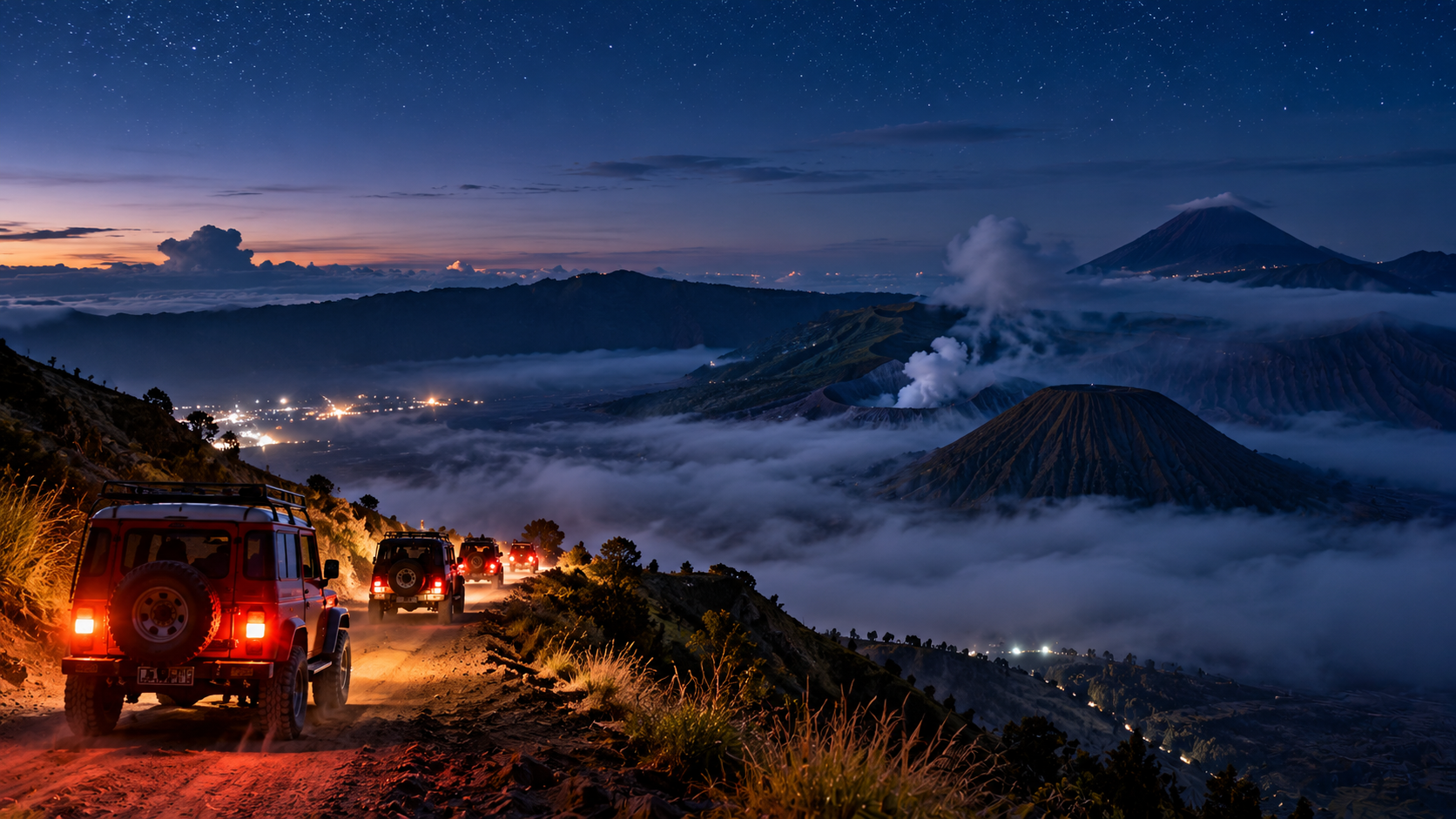
At the edge of the crater, the romance of the distant landscape disappears – here the volcano is physically felt: gray stone, sulphurous air, wind and a deep rumble from within.
Temple in the middle of a volcanic space
At the foot of Bromo there is a Hindu temple.
Against the backdrop of the vast Sea of Sand, it seems unusually small.
But its presence is a reminder that Bromo is more than just a natural landmark.
For the local Tengger people, the volcano has cultural and spiritual significance.
Therefore, a trip here should be viewed as more than just a beautiful location for photographs.
It is a living landscape, connected to local traditions and the lives of people who have lived near volcanoes for generations.
When the sun is already high
By eight or nine in the morning the mood changes completely.
The same landscape, which seemed cold and almost monochrome before dawn, becomes bright.
The sand takes on a warm hue.
Greenery appears on the slopes.
The relief of neighboring volcanoes becomes more visible.
And along with the light comes heat.
This is a good time to come back.
Most of the journey to Bromo takes place in a few hours in the morning, but afterward it feels like a whole day has passed.
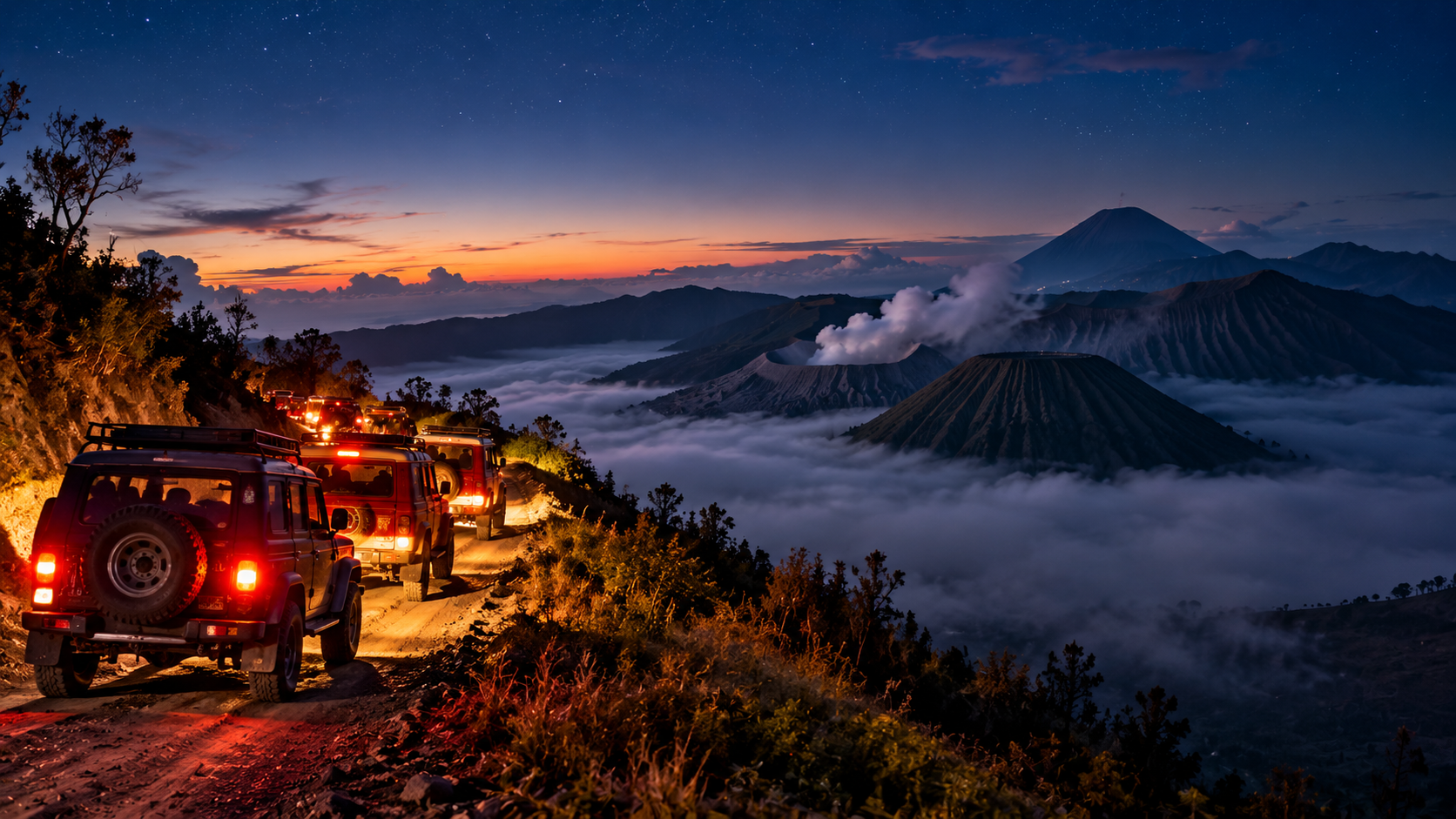
After dawn, Bromo changes: cool gray tones give way to warm light, and green patches and the complex topography of the caldera become visible on the slopes.
Don't rush after getting up at night
It is tempting to continue the busy route through East Java immediately after Bromo.
But the night departure and early rise are felt more strongly than it seems at the time of travel.
If your route allows, it's best not to plan a particularly challenging day immediately after your return.
Breakfast.
Shower.
A few hours of rest.
And only then - the next part of the journey.
This break is especially useful for those continuing their journey towards Malang, Surabaya or other parts of East Java.
What to take with you
The most common mistake is to approach Bromo as if it were an ordinary tropical excursion.
It can get really chilly in the highlands before dawn.
Warm outerwear is needed.
Closed shoes.
Water.
For the sandy part of the route, dust protection will come in handy.
During the day, the situation is reversed: the sun quickly heats up the open landscape.
That's why several layers of clothing are more comfortable than one heavy jacket.
The weather matters more than a photo on the internet.
Bromo is often represented through a perfect sunrise.
But volcanoes are not obliged to adapt to the traveler's route.
Clouds may cover Semera.
Fog may fill the caldera.
Rain - change the road.
And the state of volcanic activity sometimes affects access to certain areas.
Therefore, it is important to check current conditions and official restrictions before traveling.
Sometimes the best route is the one that has to be slightly modified.
Last look
On the way back it is interesting to look back again.
Now the volcano is already familiar.
You know where the road went.
Where the jeep was parked.
Where the climb began.
And where a few hours ago, in complete darkness, people were waiting for the first rays of light.
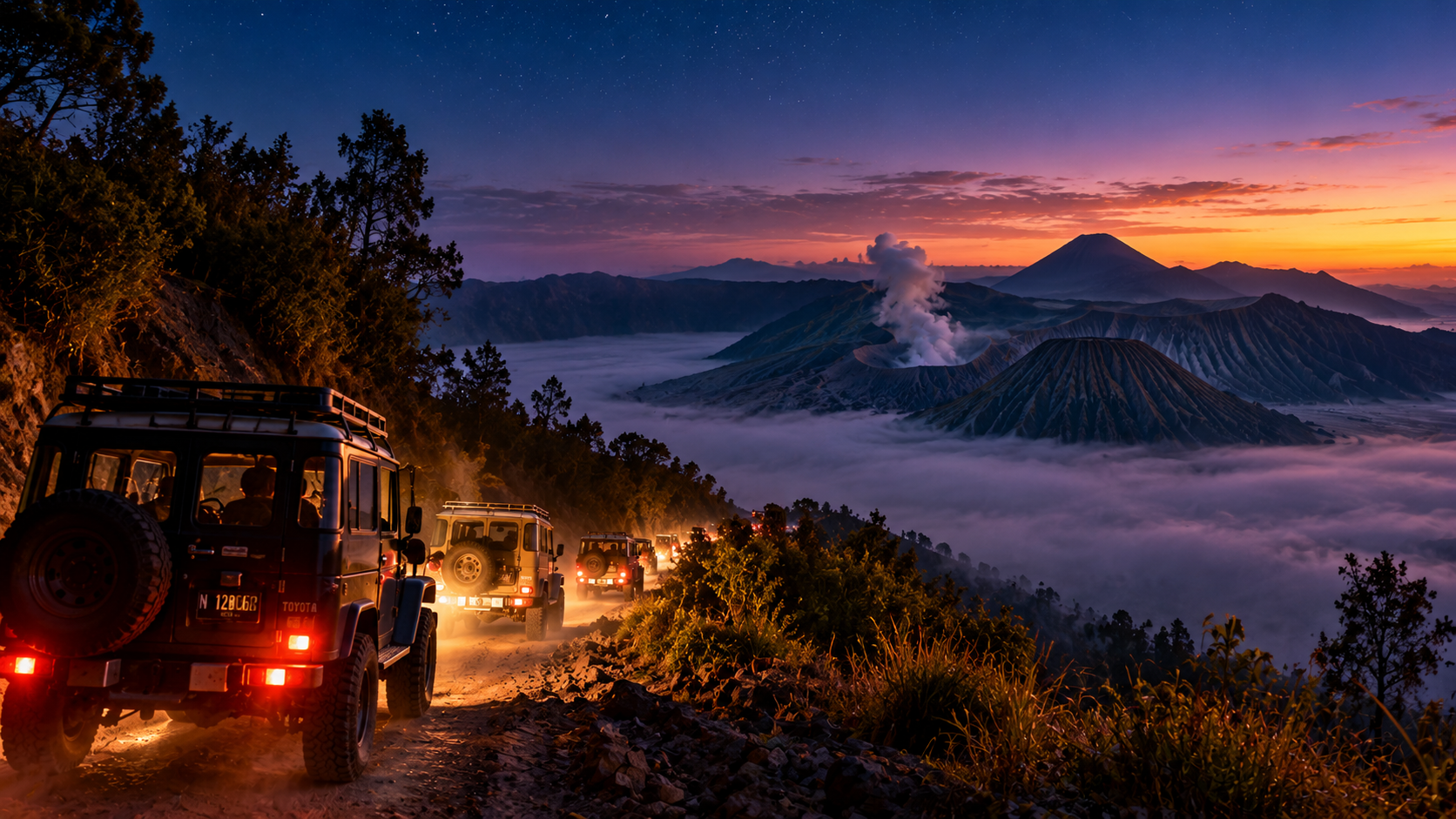
A few hours after the night start, the entire route becomes visible: the caldera, the Sea of Sand, Bromo and the mountains that were hidden in the darkness before dawn.
Bromo is remembered not only for its sunrise
The most famous photograph of Bromo is usually taken at dawn.
But the journey itself is much broader than a single frame.
It starts at night.
Continues at the observation deck.
Descends into the caldera.
Passes through the sand.
Ascends to the crater.
And it ends in the bright morning sun.
That's probably why Bromo is so memorable.
You don't just come to see the volcano.
In a few hours you see the same landscape in a completely different way.
From complete darkness to light.
From the distant panorama to the edge of the crater.
From the cold before dawn to the warm mornings of East Java.
This is no longer just a dot on the map.
This is a small journey within a big journey across Indonesia.
Comments
Share your thoughts