
Jeddah: Historic Al-Balad and the Red Sea Coast
Jeddah combines historic Al-Balad, souks, a modern promenade, and the atmosphere of the Red Sea. The city is suitable for both independent travel and as part of a Saudi Arabian itinerary.
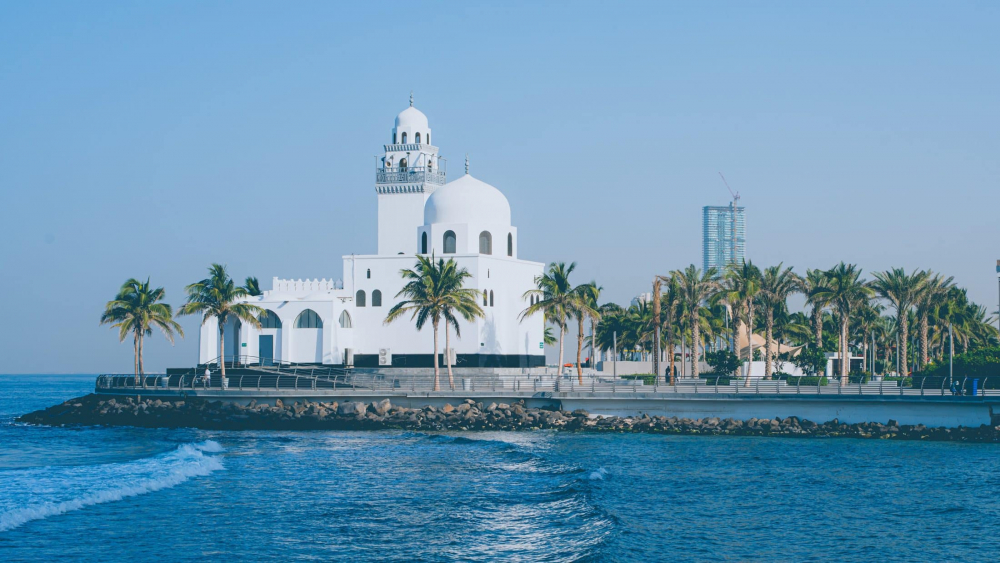
Jeddah: A city that always looks towards the sea
There are cities that are best understood through museums. There are cities that are revealed through architecture.
And the easiest way to understand Jeddah is through movement.
In the morning, among the old houses of Al-Balad. During the day, among the markets, workshops, and small cafes. Later in the evening, by the Red Sea, where the city becomes more spacious, the light softer, and the air changes with the wind.
Jeddah doesn't give the impression of being frozen in a single era. Here, the past isn't separated from modern life by a neat museum door. Old quarters, new areas, shopping streets, and the waterfront coexist.
This is precisely her character.
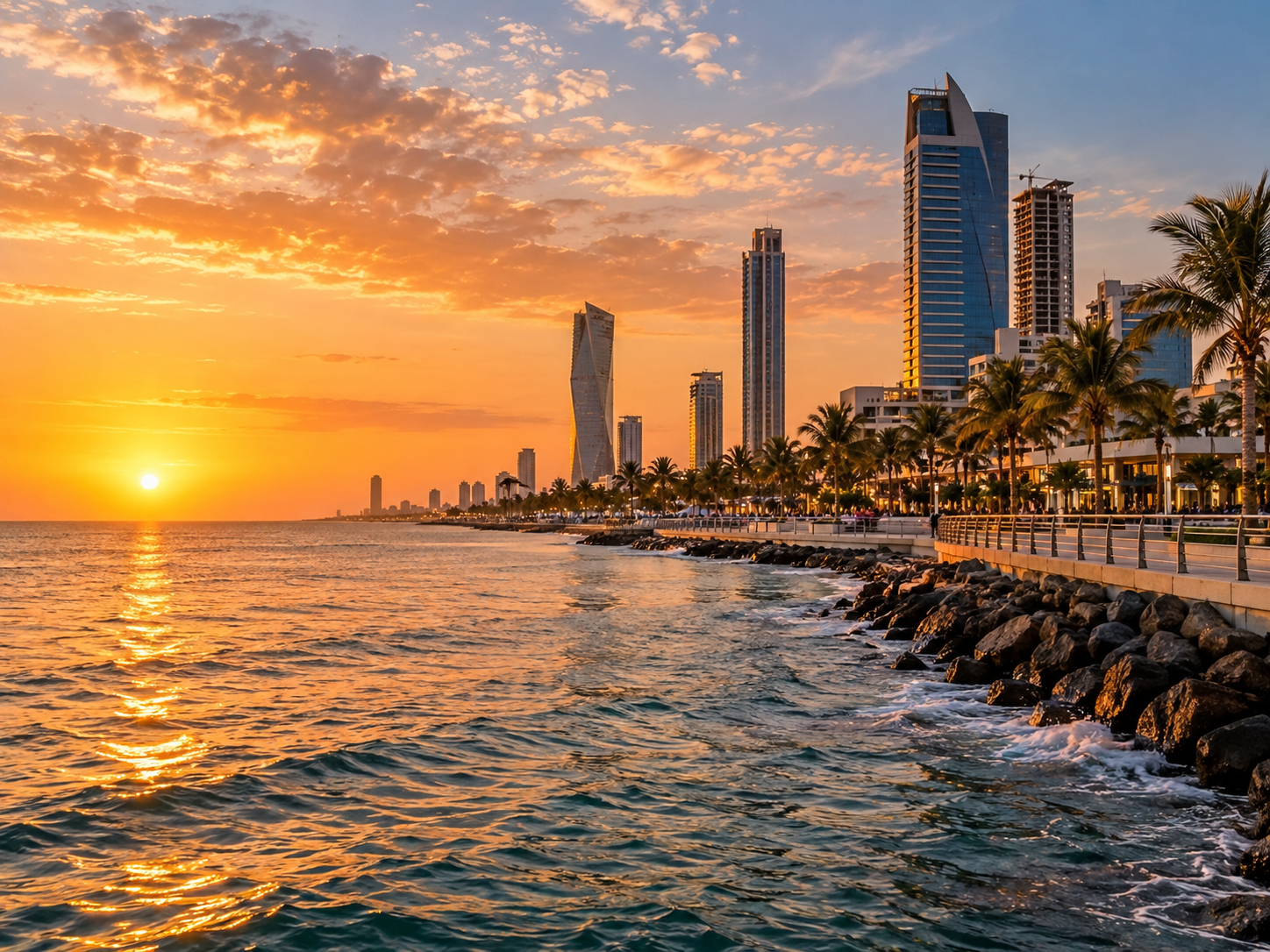
Jeddah in the evening: the city line by the Red Sea, when the heat of the day subsides and the coast becomes the center of city life.
It's worth starting where the streets become narrower
Morning in Al-Balad is completely different from evening on the modern promenade.
Here the city seems to shrink.
Wide roads are left behind, and ahead appear narrow passages, old facades, wooden elements on the windows and buildings standing so close to each other that a new fragment of the street appears around each turn.
The best way to get to know this area is not to try to go through it too quickly.
At first, the gaze catches the houses.
Then you start to notice doors.
Windows.
Balconies.
Shadows from protruding facades.
Small shops on the ground floors.
The architecture of Al-Balad developed in the conditions of a hot climate and dense urban life, so many details here had not only decorative but also practical significance.
But a traveler doesn't need to study architectural vocabulary to feel the distinctiveness of this place.
It's enough to walk a few blocks.
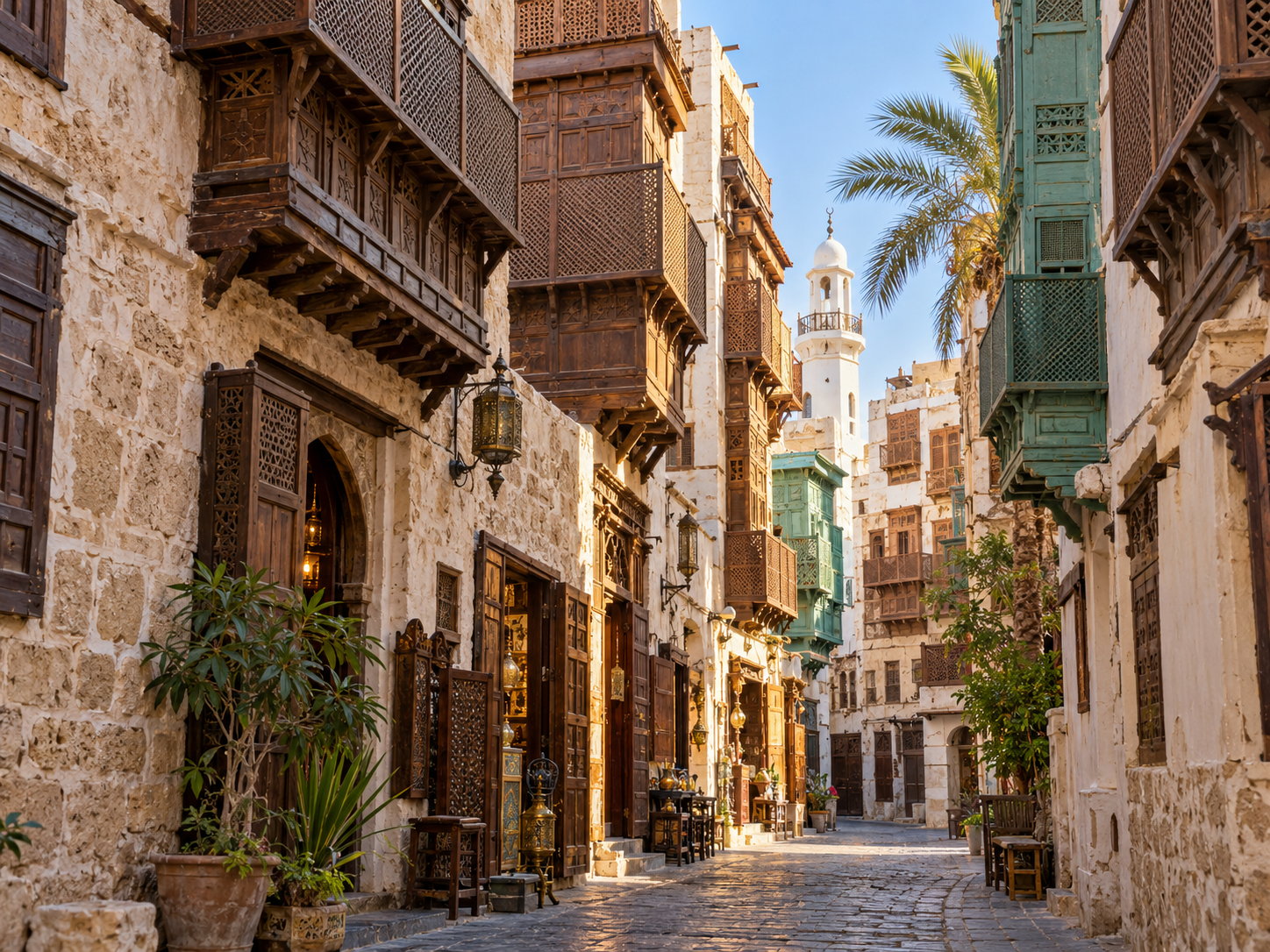
The narrow streets of Al-Balad and the old houses with their characteristic wooden facades make Jeddah a very different place from the modern coast.
Houses that tell the story of a trading city
In old Jeddah it is especially interesting to look up.
Many historic buildings seem designed to make you stop in front of them and start looking at the details.
Wooden window frames form entire geometric compositions. In one house, they are better preserved, while in another, time has noticeably altered the façade.
And it is precisely imperfection that makes the neighborhood alive.
These are not identical sets, restored for the sake of a beautiful photograph.
The city here looks lived in.
Jeddah was once an important port on the Red Sea routes, and trade left its mark not only on the city's economy but also on its architecture, culture, and population.
Goods, ideas, food, materials and people arrived here through the port.
Therefore, it is interesting to perceive old Jeddah not as a collection of historical buildings, but as evidence of a city that has been open to the outside world for centuries.
In Al-Balad, it's more interesting not to look for one "main object" but to see how history manifests itself in dozens of small details.
The market is not a pause between attractions
In some cities, the market becomes a separate tourist destination.
In Jeddah it naturally continues the street.
The smell of spices.
Fabrics.
Perfumery.
Dates.
Gold.
Small shops where the salesperson talks to a regular customer longer than the purchase itself takes.
Such places allow you to see the city not through the window of a tourist route, but through its everyday life.
It's especially nice to come here without a strict shopping list.
Then attention switches from the question “what to buy?” to a more interesting one: “how do they live here?”
You can linger at the spice shop.
Look at the habit of bargaining.
Pay attention to what products local families choose.
And suddenly it becomes clear that the market is not Jeddah's past.
He continues to be part of the present.
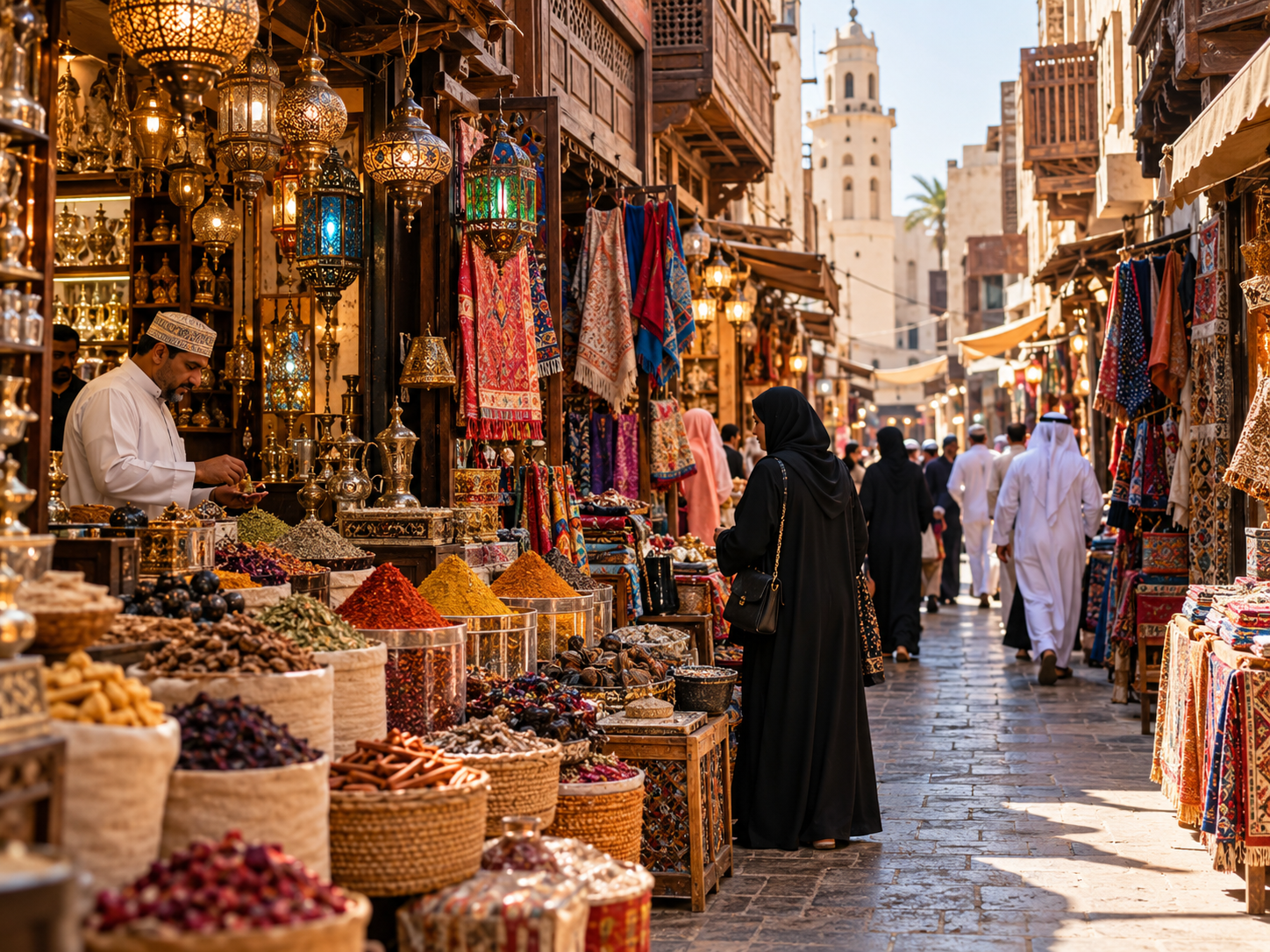
A shopping street in old Jeddah: spices, fabrics, small shops and the daily rhythm of the city.
The city changes when the sun sets
It's worth seeing Jeddah twice.
Day and evening.
The city during the day can seem fast-paced, hot, and functional. People are moving between tasks, the roads are filled with cars, and sometimes you want to pass through open spaces as quickly as possible.
After sunset, everything is perceived differently.
The air becomes softer.
More people are appearing on the streets.
The cafes are filling up.
Families go out for a walk.
And the city seems to be reclaiming the space that during the day belonged to the sun and cars.
This is especially noticeable near the sea.
The Red Sea is not the backdrop, but the other half of Jeddah
After the dense streets of Al-Balad, the coastline has an almost physical effect.
Suddenly the horizon appears.
Wind.
Open space.
Sea.
And Jeddah begins to look like a completely different city.
The embankment here is not just a place for a tourist stroll.
In the evening, it is one of the city's natural living rooms.
People walk, talk, sit by the water, children play, some come for sports, some just to watch the sunset.
You can spend an hour here and do almost nothing.
And that would be a good continuation of the day in old Jeddah.
In the morning you carefully examined the details of the wooden window.
In the evening, there are already tens of kilometers of open horizon in front of you.
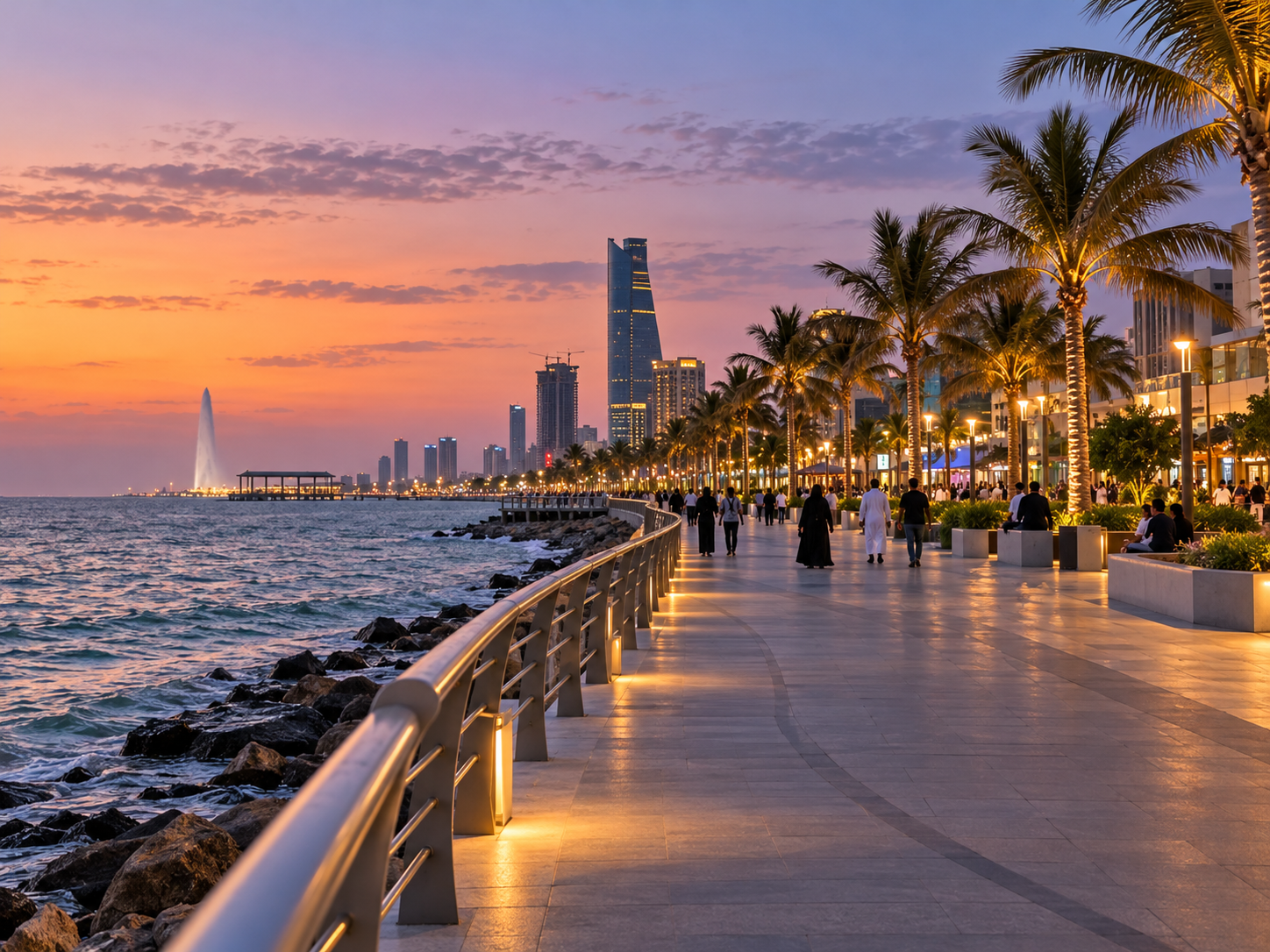
The Red Sea in the evening. After the cramped streets of the historic center, the waterfront's expanse feels especially spacious.
The sea explains the city better than many excursions
Without the Red Sea, Jeddah would be a completely different place.
For a long time, the port connected it with other shores, and the city itself served as an important sea gate for the region.
This connection can still be felt today.
In food.
In trade.
In a mixture of architectural influences.
In the very feeling of a city accustomed to welcoming people who come from afar.
Therefore, a walk along the coast is not a separate item after the “historical program”.
This is a continuation of the same story.
It’s just that now, instead of the old trading houses, a person sees the sea, along which this history once came to the city.
Jeddah is worth a taste
The city cannot be understood with just the eyes.
Especially a city like Jeddah.
What's interesting here is not being limited to a restaurant in a shopping mall or the usual international cuisine.
It's better to dedicate at least one evening to local food.
Fish and seafood dishes are especially natural in the city on the Red Sea.
But it's not just the choice of dish that's important.
The situation itself is important.
A small restaurant.
A large communal dish on the table.
Tea or coffee after meals.
A long evening without the need to move straight to the next attraction.
Such moments rarely become the main point of a tourist route.
But then, for some reason, it is precisely them that are easiest to remember.
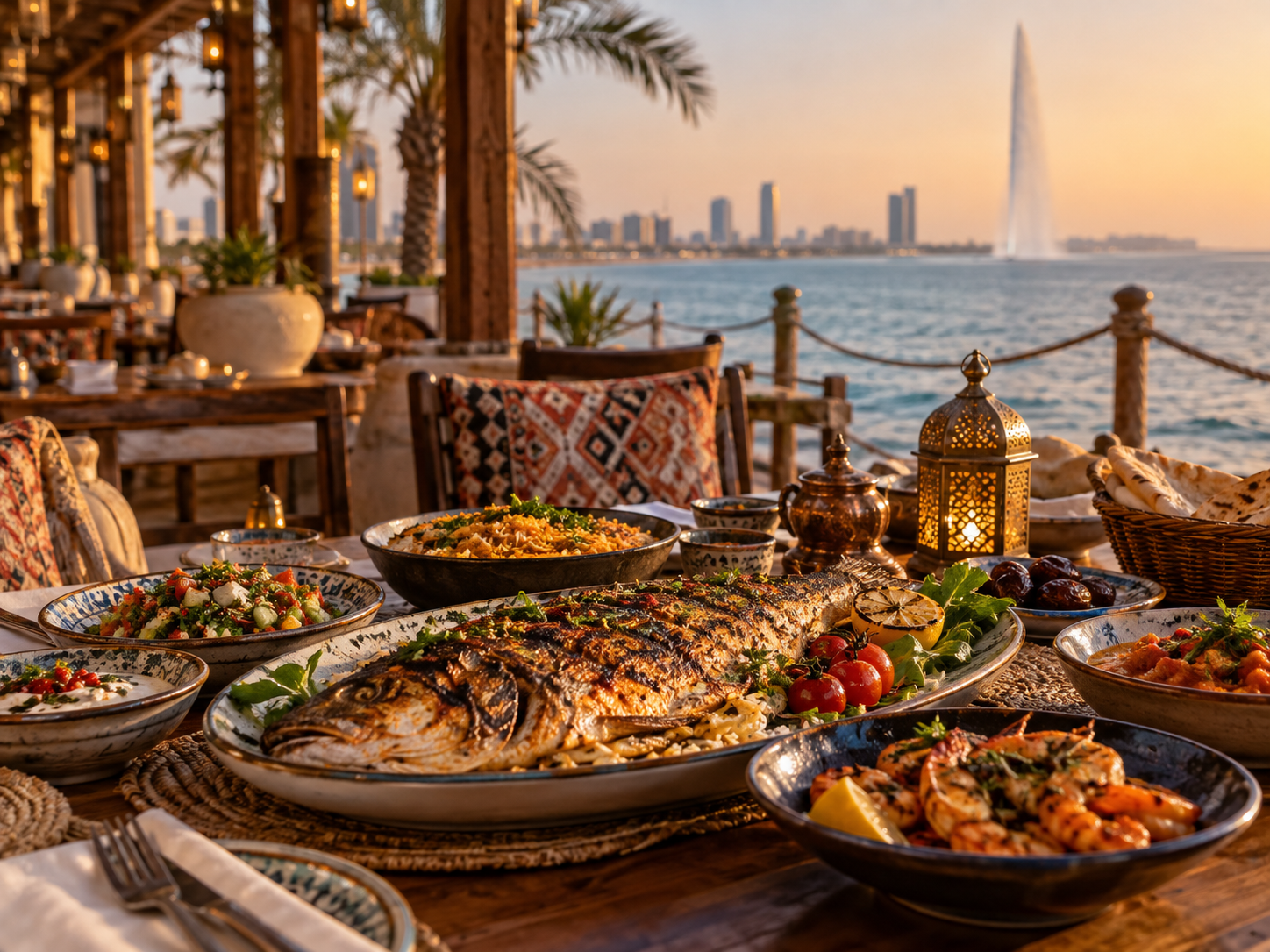
Evening dining in Jeddah: Local cuisine becomes another way to experience the port city's character.
Modern Jeddah does not argue with the old one
After Al-Balad the difference is especially noticeable.
Wide roads.
Modern buildings.
Hotels.
Restaurants.
New public spaces.
In another city, such a contrast might be perceived as a conflict.
In Jeddah, it rather shows the speed of change.
The city continues to grow and rebuild, no longer remaining merely the custodian of the historic quarter.
And therefore, a traveler should not have to choose between the “old real Jeddah” and the “new fake one”.
Both parts belong to the same city.
The historic quarters explain where it came from.
Modern - where is it heading?
One day built not by a list, but by the world
If you only have a short time in Jeddah, I wouldn't try to see as many places as possible.
It is better to plan the route around the day itself.
In the morning - Al-Balad, while you can calmly look at the architecture and walk between the neighborhoods.
Closer to midday - markets, small shops and lunch.
After the hottest part of the day, rest.
And in the evening - the Red Sea coast.
This route seems less busy on paper.
But in practice, the city is perceived as much more holistic.
You don't move between random points.
You can see how Jeddah itself changes with the time of day.
Not every trip has to be grand
Saudi Arabia offers destinations where scale matters.
Desert.
Rocks.
Archaeological sites.
Enormous distances.
Jeddah is interesting for other reasons.
Here the impression is made up of small episodes.
Old window.
Conversation between sellers.
The smell of spices.
A cup of coffee.
Wind from the sea.
A family walking along the embankment in the evening.
Reflection of city lights in water.
Each moment taken individually seems ordinary.
But together they create a city that doesn't need to be specifically turned into an adventure.
It is enough to be inside it.
Leave remembering not the sights, but the mood
After Jeddah, it is difficult to name one single scene that explains the entire city.
And perhaps this is the best compliment to him.
Some people will remember Al-Balad.
For some, it’s an evening by the Red Sea.
For some, it's a market.
For some, it's food.
And some will remember the moment when, after a long walk along the old streets, they felt the cool sea breeze for the first time.
Jeddah exists precisely between these impressions.
Between the narrow street and the open horizon.
Between the old trading house and the modern city.
Between history that has already happened and life that continues right now.
And perhaps that is why it is better not to look for a single symbol of the city here.
You just need to walk it from the old quarters to the sea.
Comments
Share your thoughts