
Java: Temples, Volcanoes, and Indonesia's Cultural Heart
Java combines ancient temples, volcanic landscapes, large cities, and traditional culture. This destination is perfect for those who want to see Indonesia far beyond the beach resorts.
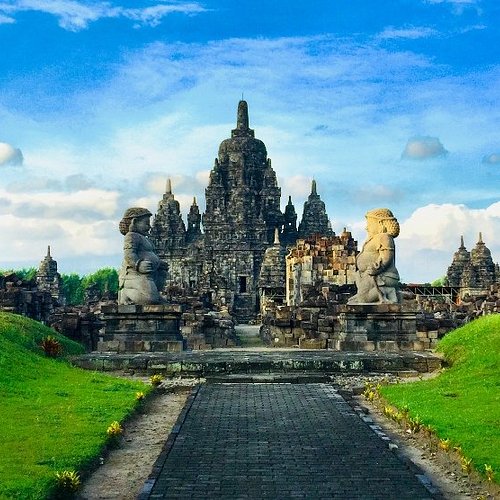
Java: An island best not viewed from a single window
There are trips where it is enough to arrive in one city, stay for a few days and calmly explore the surrounding area.
Java is designed differently.
This island makes you want to cross it.
Waking up in one place, boarding the train in the morning, and seeing a different landscape by evening. Trading bustling streets for rice fields, ancient stone temples for volcanic plains, a warm city evening for a cold morning in the mountains.
Perhaps this is why Java is remembered for more than just one landmark. It remains in the memory as a sequence of completely different states.
Today you have a city in front of you.
Tomorrow is a temple that is more than a thousand years old.
The day after tomorrow - the train goes through the green interior of the island.
And the next day the alarm rings deep into the night, because dawn is ahead over the volcanoes.
The train passes through the green areas of Central Java. On this island, the train itself often becomes part of the journey.
Yogyakarta: A City Where It's Comfortable to Start Slower
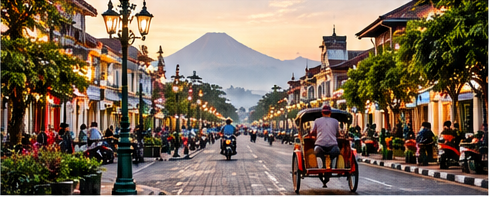
Yogyakarta doesn't give the impression of being a city that needs to be "seen".
It's more interesting to live through it for at least a few days.
In the morning, the streets gradually fill with motorcycles and small cafes. During the day, the city becomes hotter and noisier. And in the late afternoon, life comes out again: the stalls open, the smell of food appears, and people linger on the streets longer.
But Yogyakarta is important not only as a convenient point between Borobudur and Prambanan.
This is one of those cities where cultural life is not separated from everyday life.
Batik is more than just a souvenir here. Traditional patterns are still created by hand, the fabric undergoes a lengthy dyeing process, and the technique is passed down from generation to generation.
Gamelan music, theater, craft workshops, local cuisine—all of this doesn't necessarily have to be found in one "ethnographic place." It exists alongside contemporary city life.
And that's why it's best not to turn your first day in Java into a race.
Take a walk.
Sit in a small cafe.
See how the city lives.
Give yourself time to get used to the climate, noise and different rhythm.
Working on traditional batik in Yogyakarta. Such details allow us to see Java not only through monuments but also through living crafts.
Borobudur: A place to be seen slowly
People often arrive at Borobudur early.
And this is the right decision not only because of the heat.
Morning changes the perception of space.
From a distance, the temple appears to be a massive stone structure. But the closer you get, the more attention the details demand.
Levels.
Reliefs.
Steps.
Stone stupas.
Buddha figures.
Borobudur is the largest Buddhist temple complex of its kind and one of Indonesia's most famous monuments. But its size and UNESCO World Heritage status do little to explain the impression one evokes on the site.
The key here is gradualism.
As one rises higher, it is as if one leaves one layer of space behind and opens up to the next.
And all around is Central Java: greenery, hills and volcanic silhouettes in the distance.
In good weather, this combination of architecture and landscape is more powerful than any description.
I don't want to say much here.
I want to watch.
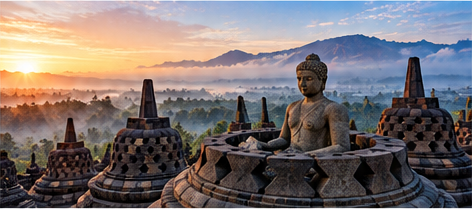
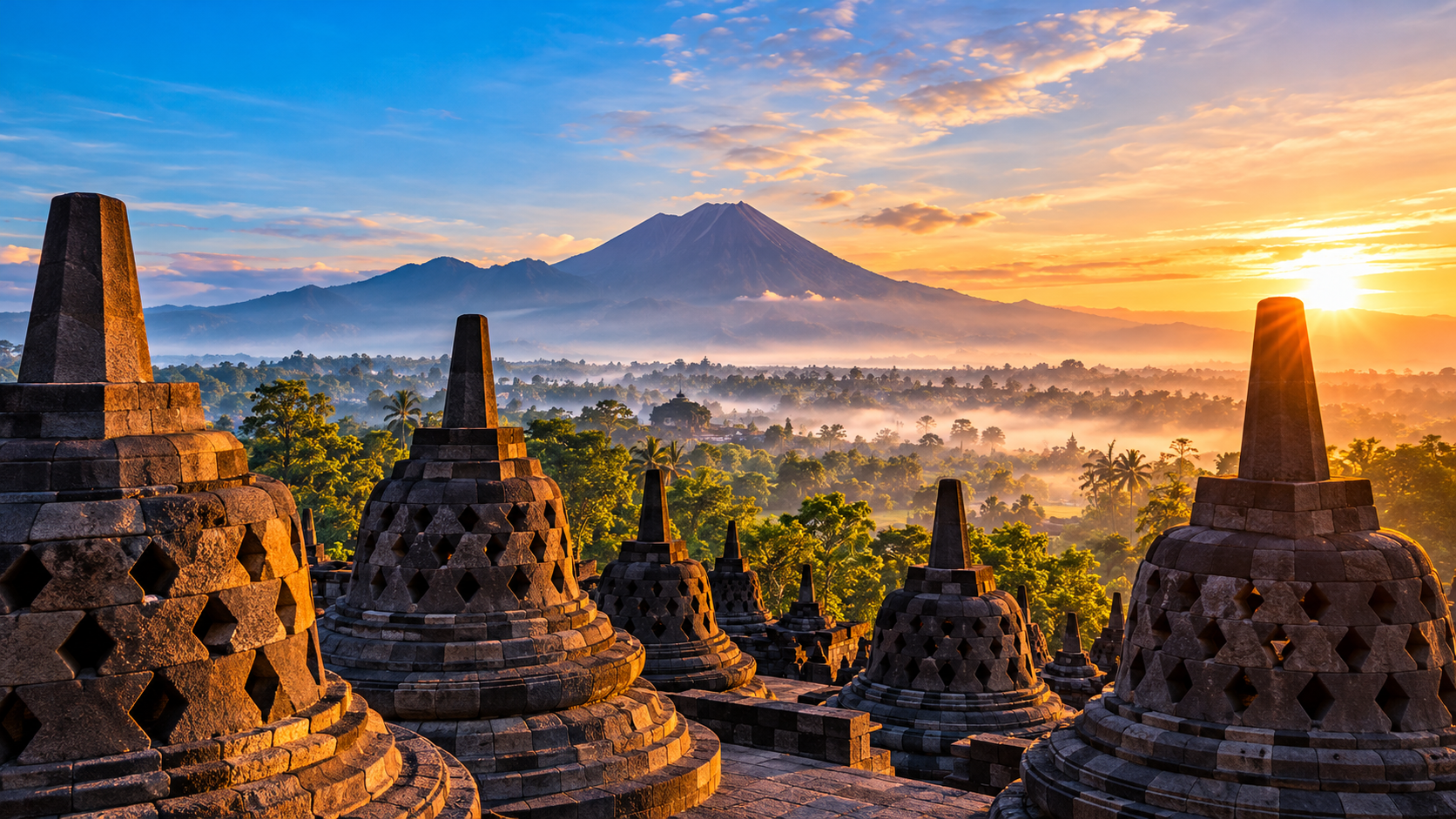
Borobudur in the early morning: stone stupas, soft light and the green landscape of Central Java.
Some historical sites impress with their sheer scale. Borobudur is more about the feeling of the journey: the longer you spend within its space, the less you feel like rushing.
Prambanan: A completely different Java on the same day
After Borobudur, it's easy to think that the second temple complex would be perceived in much the same way.
But Prambanan is arranged completely differently.
Here the gaze immediately goes upward.
Tall Hindu temple towers create a more vertical, almost dramatic silhouette. While Borobudur is perceived as a movement through levels and space, Prambanan gives the impression of architecture centered around height.
The complex is dedicated to the Hindu tradition and is also included in the UNESCO World Heritage List.
But the traveler is particularly interested in something else: two outstanding monuments are located relatively close to each other, yet they tell completely different stories.
It is here that you begin to better feel Java as a place where cultures, religions and eras intersect.
It is better to come not only for the sake of taking photographs of the main temples.
It's worth going further.
Look at the individual stone details.
Move away from the central point.
And wait for the moment when the light becomes softer.
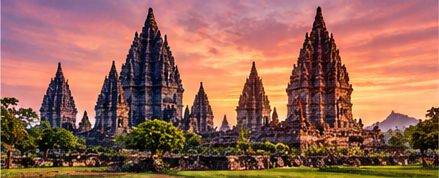
The temple towers of Prambanan in the evening light. After Borobudur, this complex feels almost completely different in character.
A train ride through Java: a few hours you don't want to cut short
There are different ways to travel between cities in Java.
But the train gives you something that the plane doesn't.
Transition.
The city is gradually ending.
Houses, small stations, fields, palm trees, villages, and mountain lines appear outside the window.
After a few hours, you notice how much the island changes.
And this is where the journey ceases to look like a collection of individual attractions.
Borobudur no longer seems like an isolated historical site.
Bromo is a distant point on the map.
Between them, real Java appears.
The one that can be seen from the train window.
Sometimes the train slows near the station. Someone gets off. Someone gets on with a bag or a box of food. Then the train continues, and the landscape begins to change again.
Watches like these rarely make it onto people's "to see" lists.
But it is they who create the feeling of a real journey.
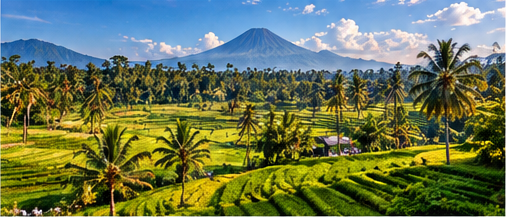
The railway, through rice fields and tropical greenery, is one of the best ways to see how Java changes between cities.
Bromo: Night ends earlier than usual
In the Bromo area, the day starts strangely.
Sometimes at two or three o'clock in the morning.
It's cold outside.
There is almost nothing left of the usual Indonesian heat.
Cars set off in the dark, and people climb to the observation points before first light.
The first minutes may raise the question: why get up so early for just one landscape?
The answer comes gradually.
The sky begins to brighten.
At first, only silhouettes become visible.
Then a huge caldera appears.
Further on is the Bromo cone, neighboring volcanoes and Mount Semeru on the horizon.
And the space suddenly takes on a scale that was unimaginable at night.
This is one of those sunrises that makes getting up early stop seeming like an inconvenience.
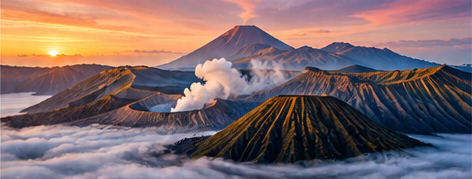
Dawn over the volcanic landscape of Mount Bromo. The cold morning and early rise are quickly forgotten as the caldera begins to emerge from the darkness.
Down to the sea of sand
But seeing Bromo from above is only half the experience.
After dawn, the route typically descends into a vast volcanic plain often referred to as the Sea of Sand.
From above, everything seemed almost motionless.
Below, the scale feels completely different.
Dust.
Dark volcanic soil.
Jeeps in the distance.
People who become small figures against the backdrop of the landscape.
And ahead lies the climb to the crater itself.
The final steps can be more physically demanding than you'd expect after an early climb. But at the crater's edge, it becomes clear that Bromo is more than just a pretty backdrop for a photo.
This is an active volcano.
The land here is a literal reminder that the island continues to change.
Why You Shouldn't Try to Shut Down Java in Three Days
On a map, Central and East Java may appear quite compact.
And the temptation arises to squeeze everything into a few days:
Yogyakarta in the morning.
Borobudur.
Prambanan.
Night move.
Bromo.
Next volcano.
Next city.
Formally, such a route is possible.
But travel quickly turns into a transportation problem.
Java is much more interesting if you leave some air between the main points.
One quiet evening in Yogyakarta.
Several hours on the train without the goal of “getting anything done.”
A normal night before an early rise.
The time after Bromo when you can just eat and relax.
Traveling restores strength not because a person is constantly on the move.
Sometimes it's the other way around.
The value of a trip appears when the familiar environment changes enough for attention to finally shift.
Instead of work tabs, there is a train window.
Instead of notifications - the road.
Instead of familiar streets, there is a volcano on the horizon.
And for some time the brain has to live with what is directly in front of the eyes.
Not only to see, but also to return as different
After Java, it is rare that one main image remains in the memory.
Several come to mind at once.
Fog around Borobudur.
The tall towers of Prambanan.
Train window.
Fields.
The cold before dawn.
First light over Bromo.
Fatigue after getting up.
A hot drink after hours in the wind.
And it is the combination of these episodes that makes the trip complete.
Java shows that travel does not necessarily have to be a vacation in the traditional sense of the word.
Sometimes the best vacation is a completely different life for a few days.
Different routine.
Other distances.
Other sounds.
Other tasks.
And then you get home and notice a strange thing: an ordinary day seems a little less difficult.
Not because traveling solved all the problems.
It's just that for a while the world was much bigger than the daily grind.
And sometimes this is exactly what a person lacks.
Comments
Share your thoughts