
Komodo: Islands, Sea, and a Journey Among Unique Nature
Komodo National Park offers boat routes, small islands, viewpoints, and unique natural beauty. One of the best ways to explore the region is by boat.
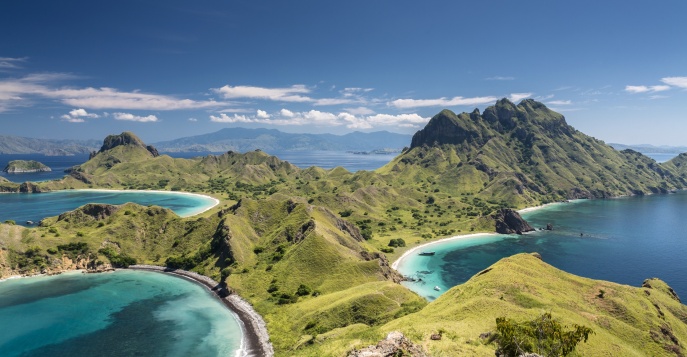
Komodo: A Journey to Where the World Gets Quieter
There are places you want to see for the sake of photography. There are places you go for the history, the architecture, or the sea.
And there is Komodo.
It's worth coming here for more than just a single photo, or even just for the famous monitor lizards. The main impression of this region emerges gradually: as the port is left behind, the boat sets out to sea, your phone is less and less in your hand, and days begin to be measured not by meetings and messages, but by sunrises, islands, and the distance to the next bay.
Komodo is a journey where the journey itself becomes part of the holiday.
The national park is located between the islands of Sumbawa and Flores and includes three large islands—Komodo, Rinca, and Padar—as well as numerous smaller islands. It features dry savannah landscapes, bays, beaches, and a rich marine ecosystem. The park has been listed as a UNESCO World Heritage Site since 1991. UNESCO World Heritage Center
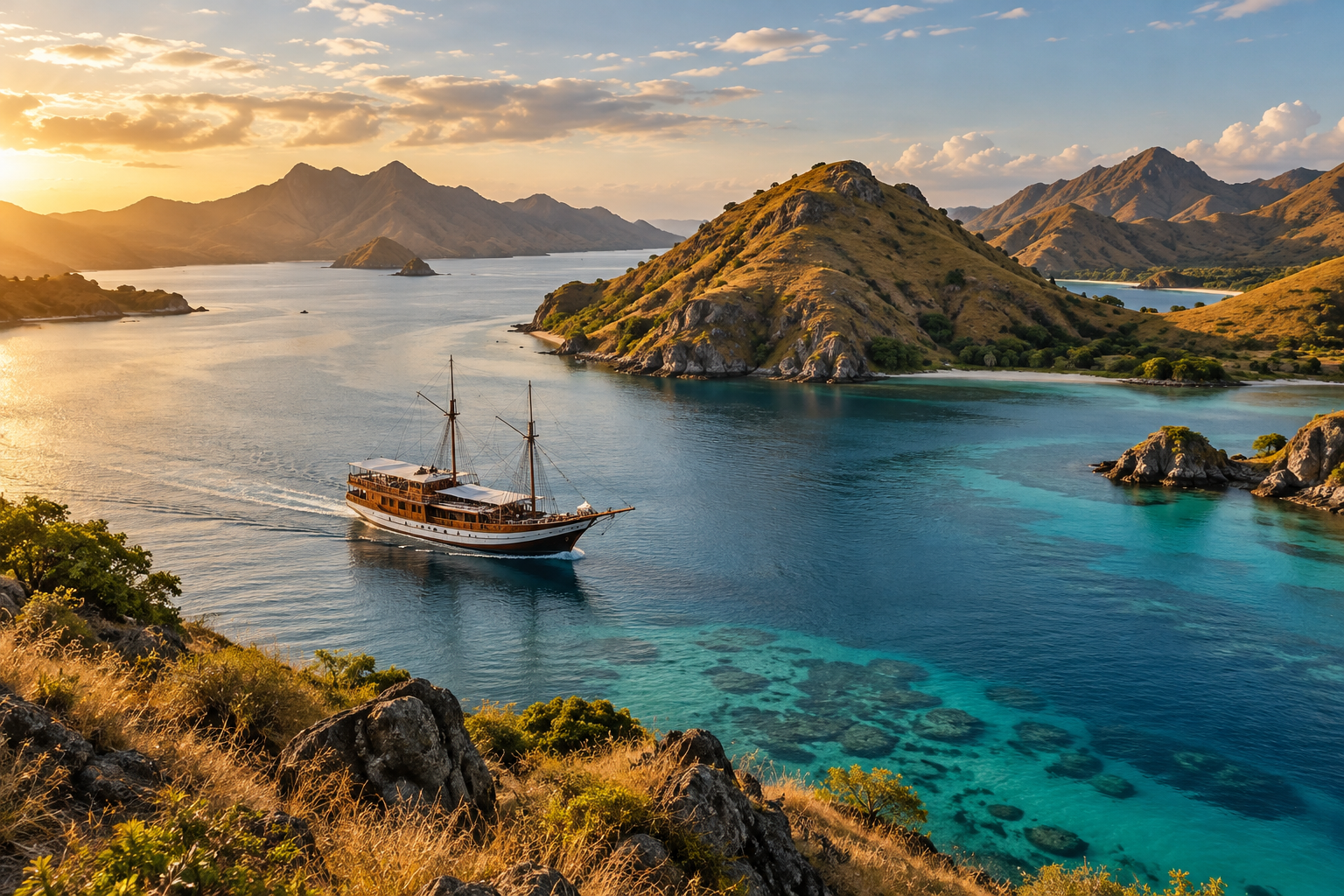
Labuan Bajo: Where the City Ends and the Sea Begins
For most travelers, their Komodo experience begins in Labuan Bajo, on the western tip of Flores.
In the first hours, this city seems like an ordinary starting point: hotels, cafes, a port, boats, people with backpacks, final preparations before setting out to sea.
But this is where the rhythm changes.
On land, we're used to thinking in terms of distance: how many kilometers, how many minutes by car, when's the next stop. In Komodo, space is perceived differently. There are no traditional roads between the islands. Instead, there's water.
The boat becomes more than just a means of transport.
For a few days it turns into a small house, an observation deck and a place where you finally have time to just look around.
The shore gradually disappears behind us. Ahead, only the sea and the outlines of the islands remain.
And at some point a simple feeling comes: there is nowhere left to rush.
Padar: When the landscape doesn't reveal itself immediately
One of the most famous places in the region is the island of Padar.
Its panorama is easily recognizable from photographs: several bays on either side of an elongated mountain range, dry slopes and the sea on almost all sides.
But the photograph only shows the result.
The real experience begins during the climb.
At first, only part of the shore is visible. After a few minutes, the trail climbs higher—and another bay appears. Then another stretch of sea. Another island in the distance.
The landscape seems to come together gradually.
At the top, it becomes clear why Komodo differs so much from the familiar image of tropical Indonesia. There's no endless greenery here. Dry savannah slopes predominate in many places, looking especially striking next to the vibrant sea and clear beaches—it's this contrast that UNESCO notes in its description of the park's natural heritage. UNESCO World Heritage Centre
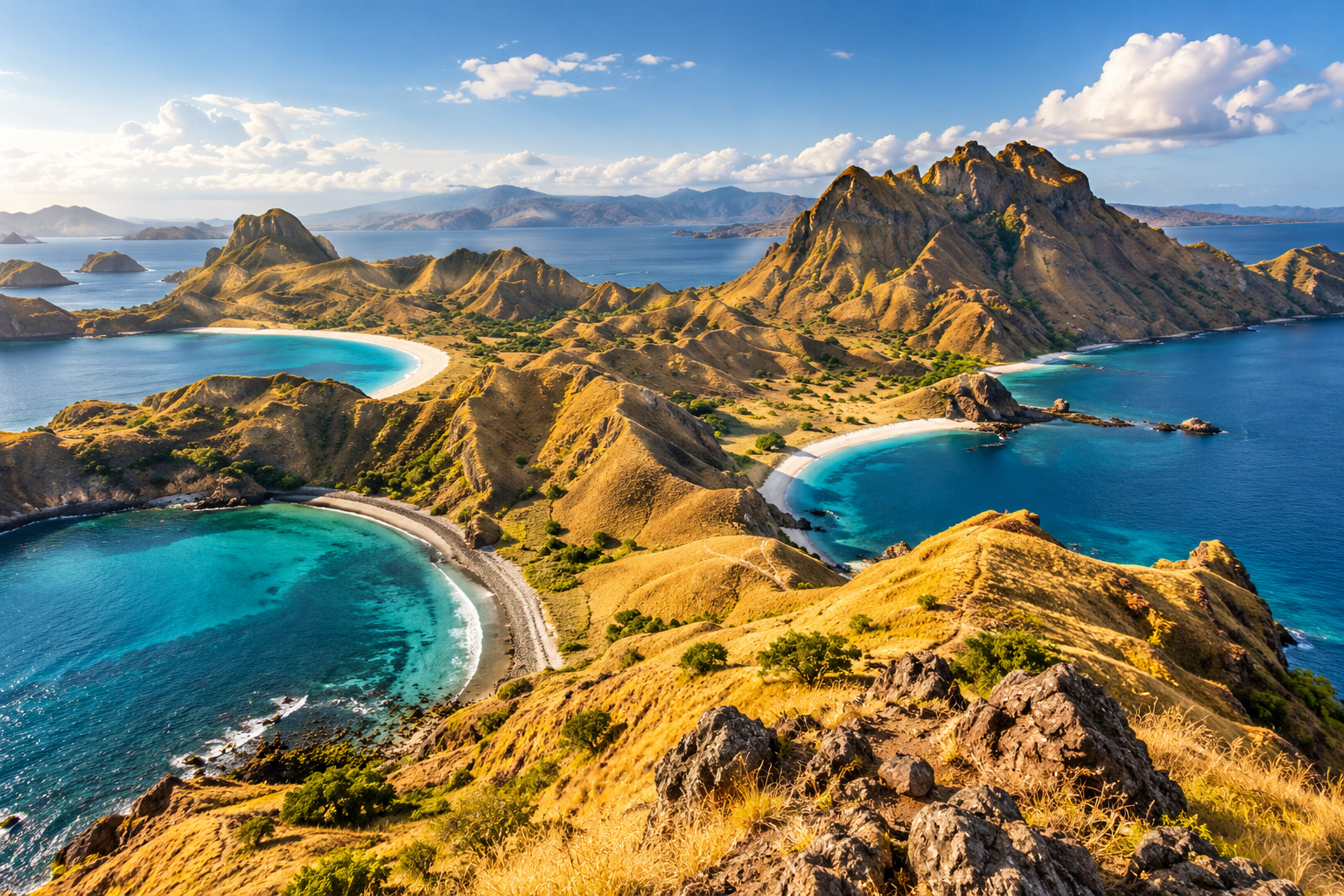
View from Padar: one of the most recognizable panoramas of the archipelago.
Sometimes it's helpful not to take out your phone right away.
Just stand for a few minutes.
Feel the wind.
Watch as the boats become little dots below.
Moments like these remind us that travel isn't just about the number of places you see. Sometimes, a single landscape, given enough time, lingers in your memory more than a whole day filled with stops.
Encounter with a Komodo Dragon: Humans are not the boss here
Komodo has gained worldwide fame thanks to the largest modern lizards, the Komodo dragon.
These animals survive in the wild only in a limited part of Indonesia. UNESCO indicates that the main wild population is concentrated on Komodo, Rinca, Gili Motang, and certain coastal areas of Flores. UNESCO World Heritage Centre
But it’s better to view an encounter with a monitor lizard not as just another tourist attraction.
The meaning here is just the opposite.
This is not an animal that is on our territory.
This man comes into his environment.
Therefore, it is especially important to follow the instructions of those accompanying you, keep your distance, and not try to get closer for the sake of a spectacular photo.
The Komodo dragon has an almost prehistoric appearance: a heavy body, strong limbs, slow movements that can instantly change to speed.
When you see it not through a screen, but in its natural environment, your attitude towards the place changes.
At this point, Komodo ceases to be just a beautiful archipelago.
It becomes clear that this is, first and foremost, a living ecosystem that the traveler only visits temporarily.
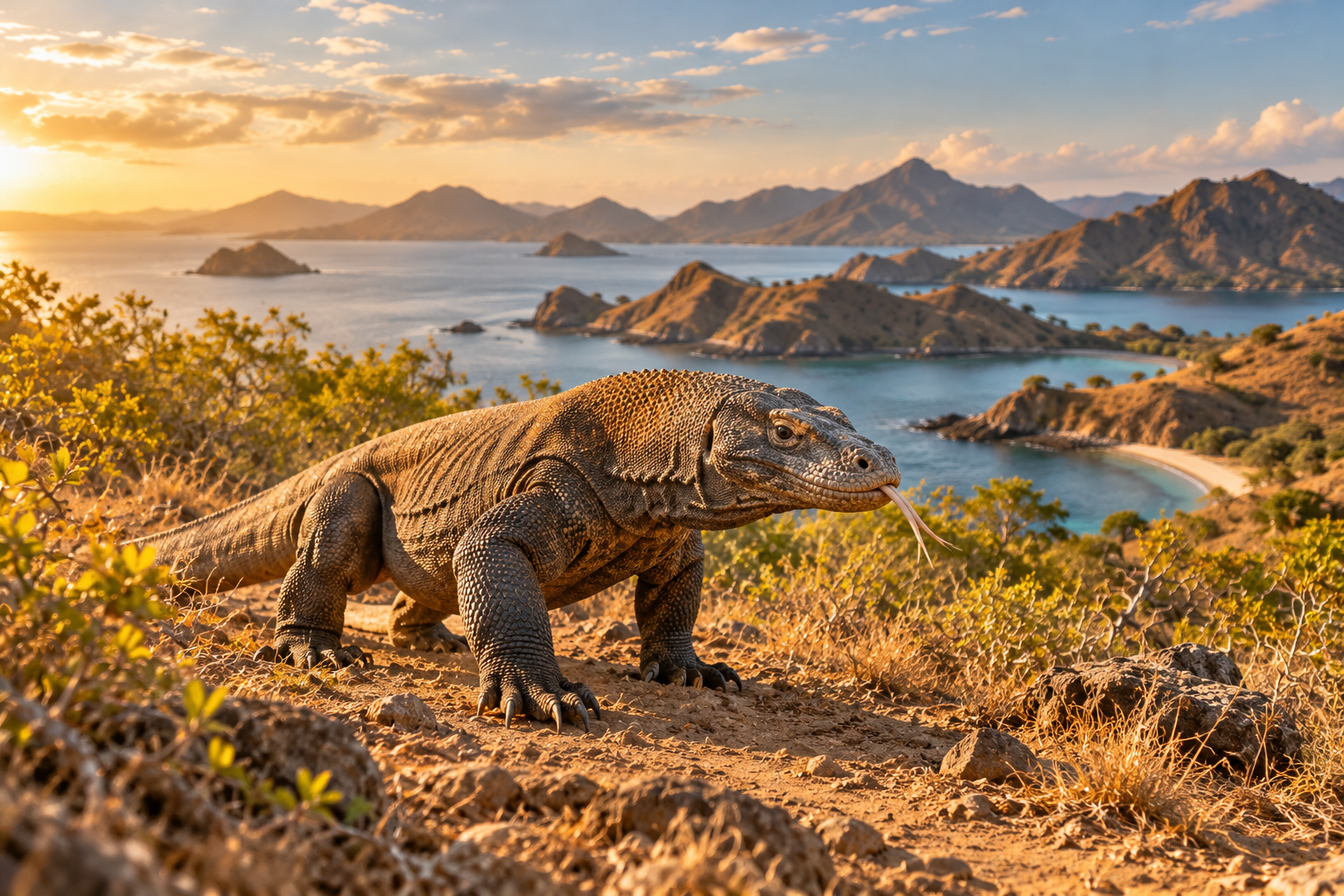
A Komodo dragon in its natural habitat. Observations should only be made from a safe distance and in accordance with park regulations.
The world under water
The most famous part of Komodo is on land.
But a huge part of the region's life is hidden beneath the sea's surface.
UNESCO specifically notes the park's rich coral reefs, sea turtles, dolphins, whales, dugongs, and other marine species. Strong currents and water exchange make this ecosystem particularly productive. UNESCO World Heritage Center
That is why it is difficult to imagine a journey here as just a series of landings on islands.
At some point you just want to put on a mask and go under the water.
Outside there is sun, a boat and dry hills.
Underwater is a completely different world.
Coral relief, fish, movement of light, almost complete silence.
There is a special state that occurs during snorkeling: thoughts become simpler.
It's impossible to look at marine life and keep scrolling through work tasks at the same time.
Attention returns to the present moment.
That's why travel is often such a wonderful way to refocus. It doesn't necessarily "cure" or solve pent-up problems. But a new environment helps temporarily break out of the usual cycle and refocus on things that can't be seen from the office or car.
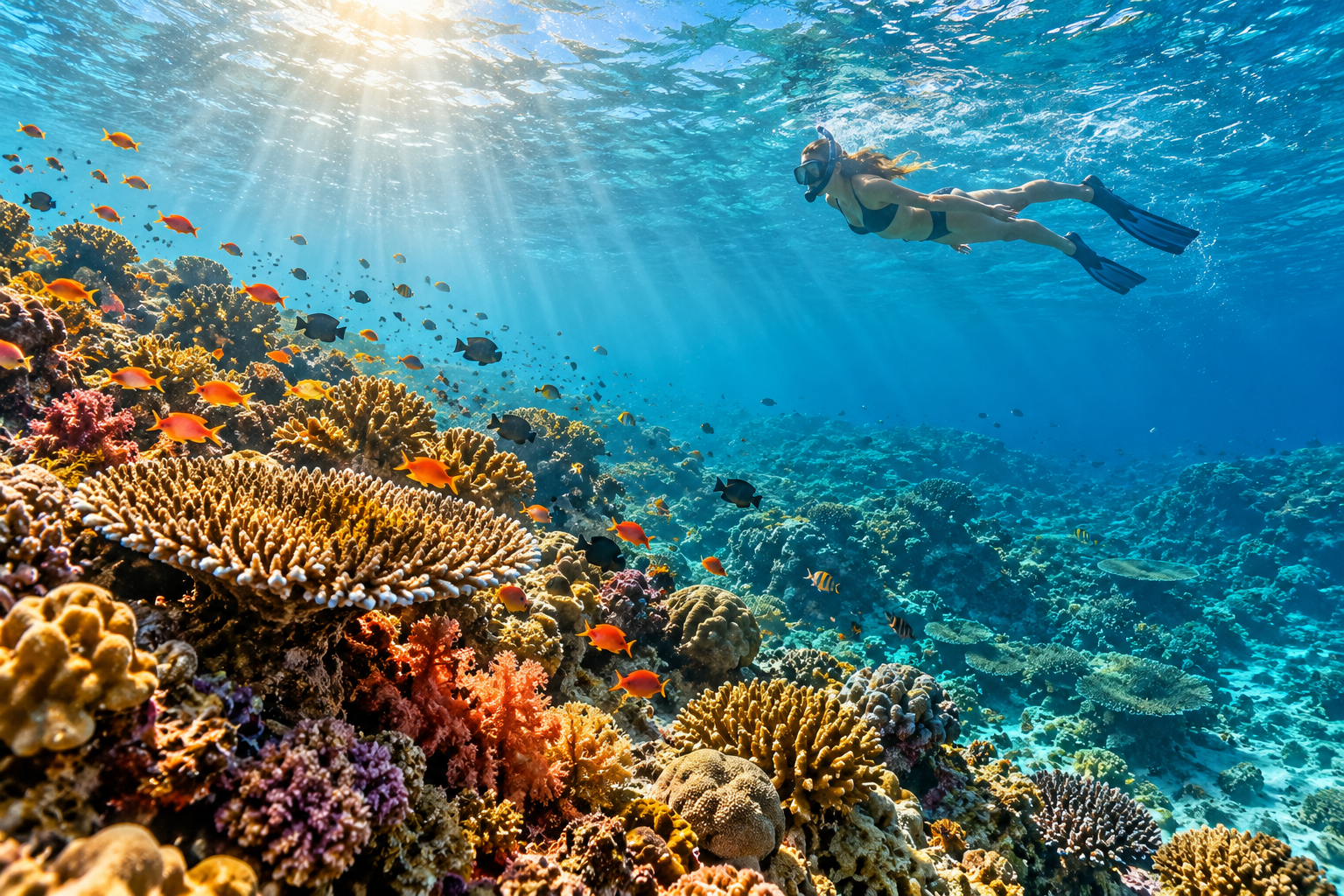
Komodo's marine ecosystem is no less important than its famous island landscapes.
Pink shore in the middle of the blue sea
Some of the region's beaches are famous for the pinkish hue of their sand.
But even here, the most interesting thing is not the attempt to find the brightest possible shade for the photograph.
The overall contrast works much more powerfully.
Dry Island.
Turquoise water.
Light sand with a warm tint.
Small boats near the shore.
After several hours at sea, such a stop feels almost like a natural pause.
You can go out to the shore, walk barefoot along the water and not plan anything for at least the next twenty minutes.
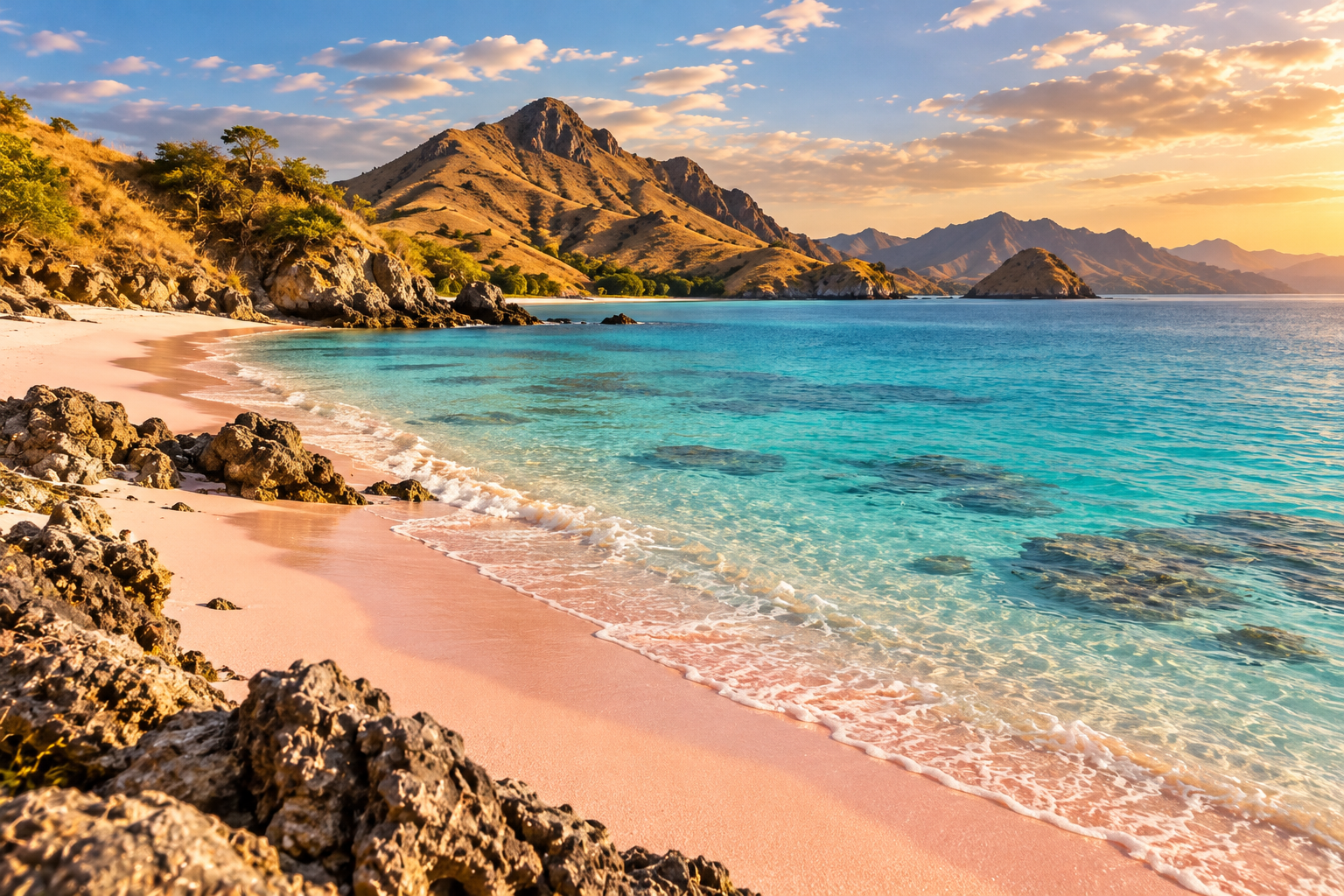
One of the bright beaches in the Komodo region. The sand's color changes depending on the light, humidity, and the specific stretch of coastline.
Why you shouldn't try to see everything here
There are some trips that can easily be ruined by being overly busy.
Komodo is one of them.
It's very easy to create a route so that every hour a new point is occupied:
Padar.
Beach.
Monitor lizards.
Snorkeling.
Another island.
Another bay.
Sunset.
On paper, this plan looks perfect.
But in reality, after a few days, it may turn out that a person has remembered not the places, but the constant rush between them.
Komodo dragons open up better more slowly.
Sometimes it's worth leaving an hour on your route without a task.
Sit on the deck.
Look at the horizon.
Drink some tea.
Or just do nothing.
A good trip isn't always the one where you see the most. Sometimes it's more valuable precisely because, for the first time in a long time, you don't have to rush anywhere.
A sunset that doesn't require a program
The sea often becomes calmer in the evening.
The sun gradually sets behind the islands, the dry hills darken, and the water changes color several times in a few minutes.
At this point, it is no longer particularly important how many points you managed to visit in a day.
Nobody checks the route.
I don't receive a notification about the next meeting.
No need to switch between dozens of tasks.
There is only a boat, the sea and the light that is slowly fading.
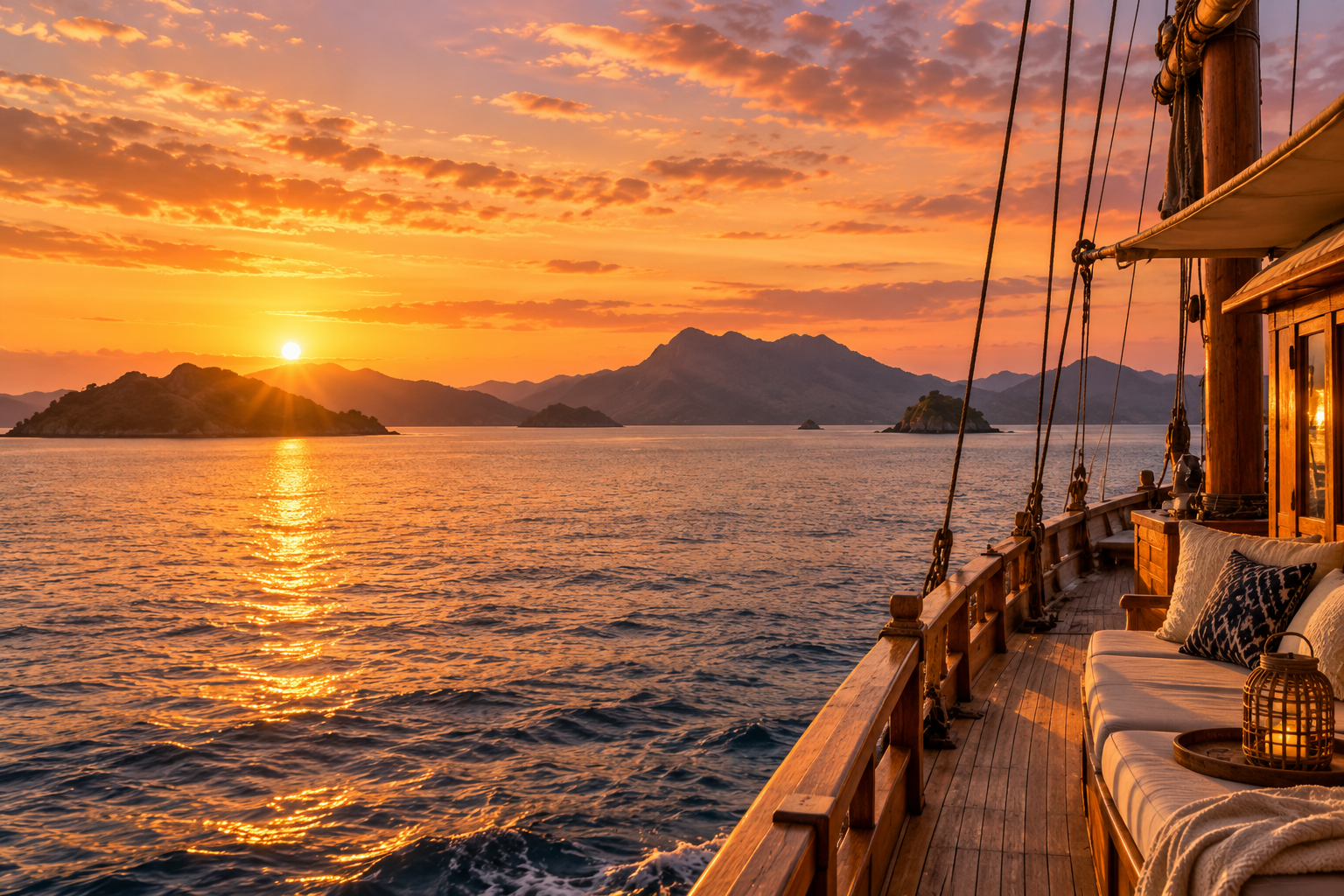
An evening between islands is a case where the pause itself becomes part of the journey.
Moments like these seem very simple.
But often it is they who remain in the memory the longest.
Several days without the usual rhythm
We often talk about rest as the absence of work.
But physically not working and actually switching are not the same thing.
You can spend the weekend at home and still check your messages every ten minutes.
You can go on vacation and still mentally be in the office.
Traveling to a place like Komodo works a little differently.
The environment changes so much that old habits begin to fade away on their own.
Instead of a road there is a sea.
Instead of a ceiling in the morning, there is light from behind the islands.
Instead of constant city noise, there is the boat's engine, wind and water.
New experiences require attention.
And gradually the brain stops clinging to the usual sequence of tasks.
This does not mean that life will be perfect after traveling.
But a few days in a completely different rhythm sometimes allow you to return home more focused – simply because you’ve once again experienced what a day looks like without the constant pressure of information.
Travel and don't destroy the place you came for
The more beautiful a destination becomes, the more important the behavior of the travelers themselves becomes.
Komodo is a protected area with valuable terrestrial and marine ecosystems. Among the threats monitored by conservation agencies, UNESCO cites tourism pressure, poaching, and destructive practices in the marine environment. UNESCO World Heritage Centre
Therefore, simple rules are especially important here:
Do not approach wild animals for the sake of photography;
follow the instructions of staff and accompanying persons;
do not leave litter;
do not touch the corals;
do not take natural objects as souvenirs;
select operators who comply with national park regulations;
treat the islands as a living environment, not as decoration.
Responsible tourism does not start with loud slogans.
It starts with the behavior of one person.
Return to Labuan Bajo
By the time the boat returns to port, Labuan Bajo has a different feel.
Before the journey, the city was the beginning of the route.
Now it means return.
Roads, shops, Wi-Fi, cars, and schedules reappear.
And suddenly it becomes noticeable how quiet the last few days have been.
This is perhaps one of the most interesting features of a good trip.
You return to the same place.
But you perceive it a little differently.
What remains after Komodo
Photos remain on the phone.
Panorama of Padar.
Monitor lizard.
Underwater world.
Pink Coast.
Sunset.
But the real value of travel often comes later.
When you're at home and suddenly want to go for a walk instead of staring at the screen for another hour.
When you start to pay more attention to your free time.
When you realize that relaxation doesn't have to be endless fun.
Sometimes all a person needs is a change of environment, slowing down, and looking at the world around them a little more attentively for a few days.
Komodo provides rare space for this.
At first it seems like you're coming here for the islands.
And then you realize that the most valuable thing about such a journey is the opportunity to briefly step out of your usual life and hear the silence that you had long since stopped noticing in it.
Comments
Share your thoughts