
Labuan Bajo: Gateway to the Komodo Islands and Sea Travel
Labuan Bajo is a small port town on the western side of Flores Island and the main starting point for Komodo National Park. Here, the journey begins with the harbor, boats, islands, and evening panoramas over the sea.
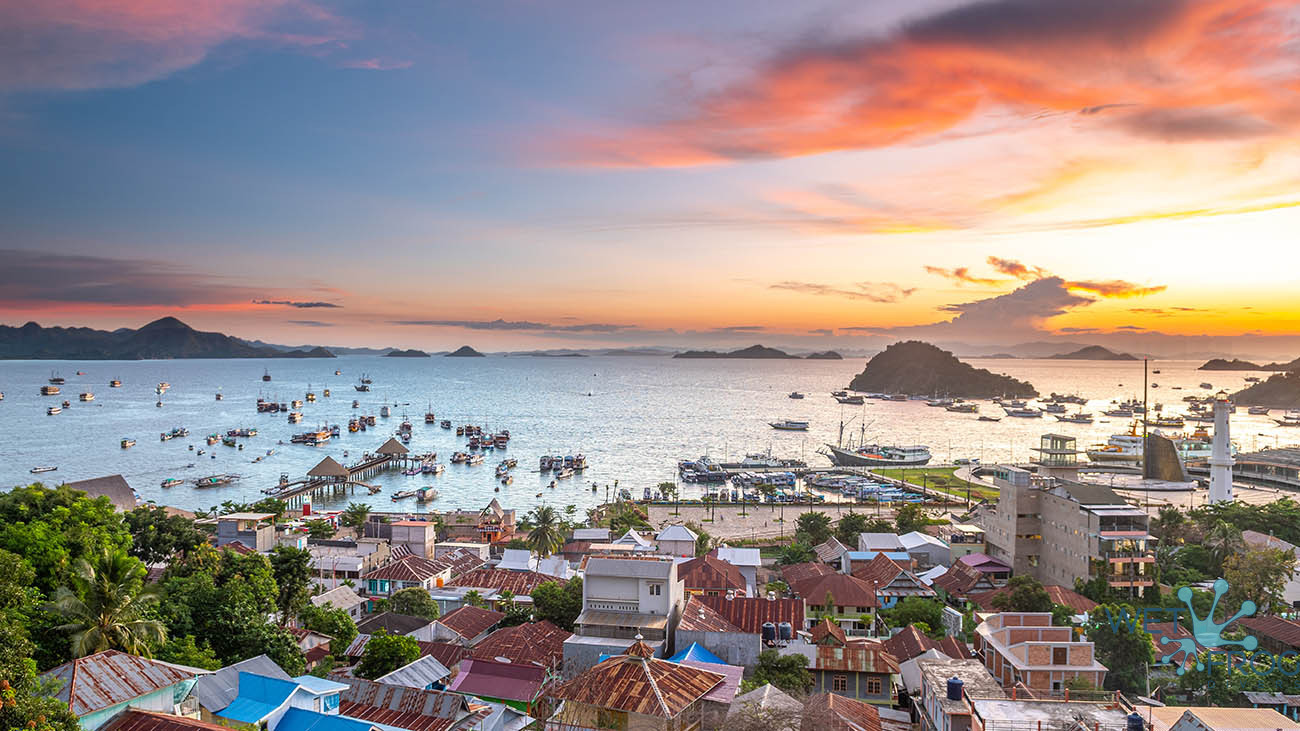
Labuan Bajo is rarely a travel destination in itself.
Most often, people come here for what comes next.
For the sake of the boat that leaves the pier in the morning.
For the sake of the islands appearing one after another on the horizon.
For the sake of Komodo National Park, Padar, Rinca and water of a color that is hard to imagine until you see it with your own eyes.
But if you don't rush straight to the sea, Labuan Bajo gradually reveals itself as a separate part of the journey.
It is a small port town that lives to the rhythm of boats, sunsets and the constant movement between the mainland and the islands.
It smells like the sea here.
There are dozens of ships on the water.
Hotels and small cafes are appearing on the hills.
And in the evening, almost the entire city seems to turn its face to the west to watch the sun set behind the islands.
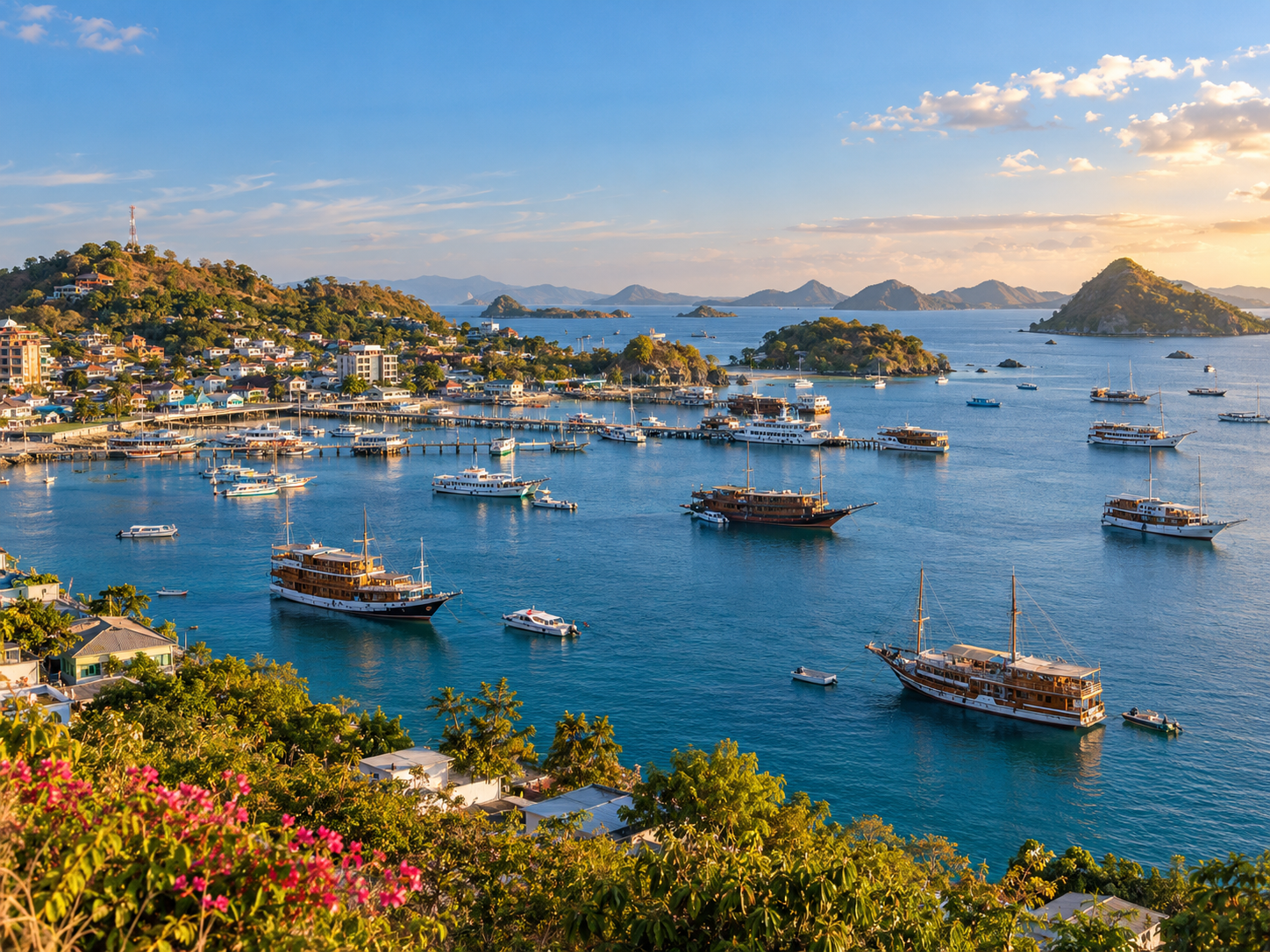
Labuan Bajo Harbor is the opening scene of a great sea voyage: dozens of boats, calm waters, and islands that begin just beyond the city limits.
A city that looks out to sea
Labuan Bajo is located on the western tip of Flores Island.
Its geography almost immediately explains the character of the city.
On one side there are hills and a road leading into the interior of the island.
On the other hand, there is a harbor and a vast expanse of sea.
Most of a traveler's life here is connected in one way or another with water.
Some people come for one day before heading to Komodo.
Some people stay for several nights.
Some people return here after a multi-day boat expedition just to sleep, have dinner, and feel solid ground under their feet again.
This is why the city is not perceived as a classic resort.
It's more of a port between two journeys.
Morning at the harbor
Early mornings in Labuan Bajo begin before most cafes come to life.
Engines can already be heard in the port.
Crews load water, food and equipment.
Travelers gather at the piers.
Small speedboats sit alongside larger, traditional vessels designed for days at sea.
It is at this moment that the role of the city is especially felt.
Labuan Bajo is the gateway.
The archipelago begins behind them.
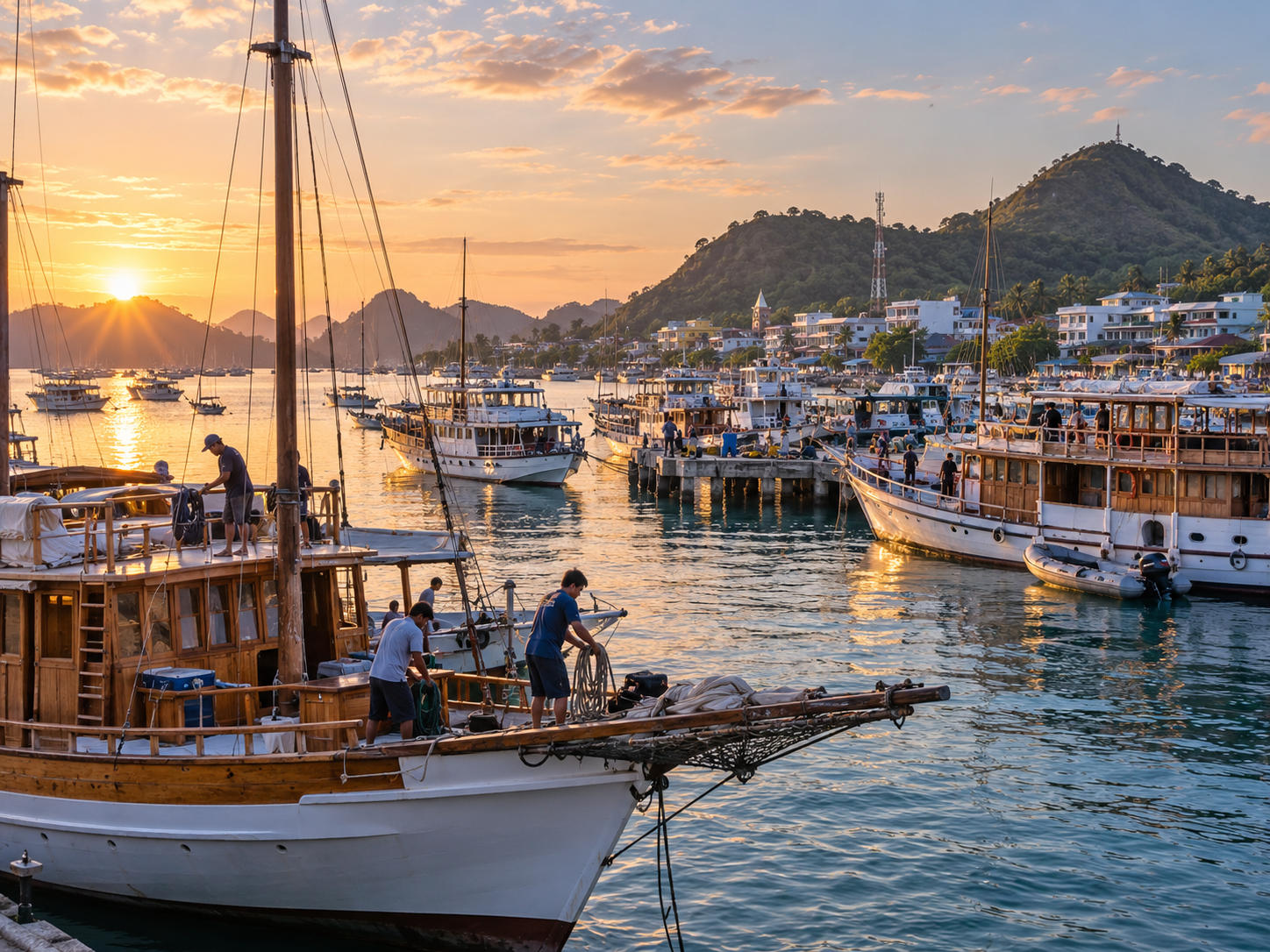
While the city is just waking up, the harbor is already living its life: crews are preparing boats, and routes to Komodo are starting a new day.
Padar is an island recognizable by its silhouette.
One of the most famous places in the region is the island of Padar.
Its shape has become almost a symbol of travel through Komodo National Park.
Several bays appear before the eyes at once from a high point, and the lines of hills divide the sea into different shades of blue.
The rise usually begins early.
It's not the longest walk, but the heat and exposed terrain quickly remind you that you're in a tropical region.
Everything is changing at the top.
The boats are getting small.
The banks form smooth lines.
And the islands around look as if they continue to the horizon.
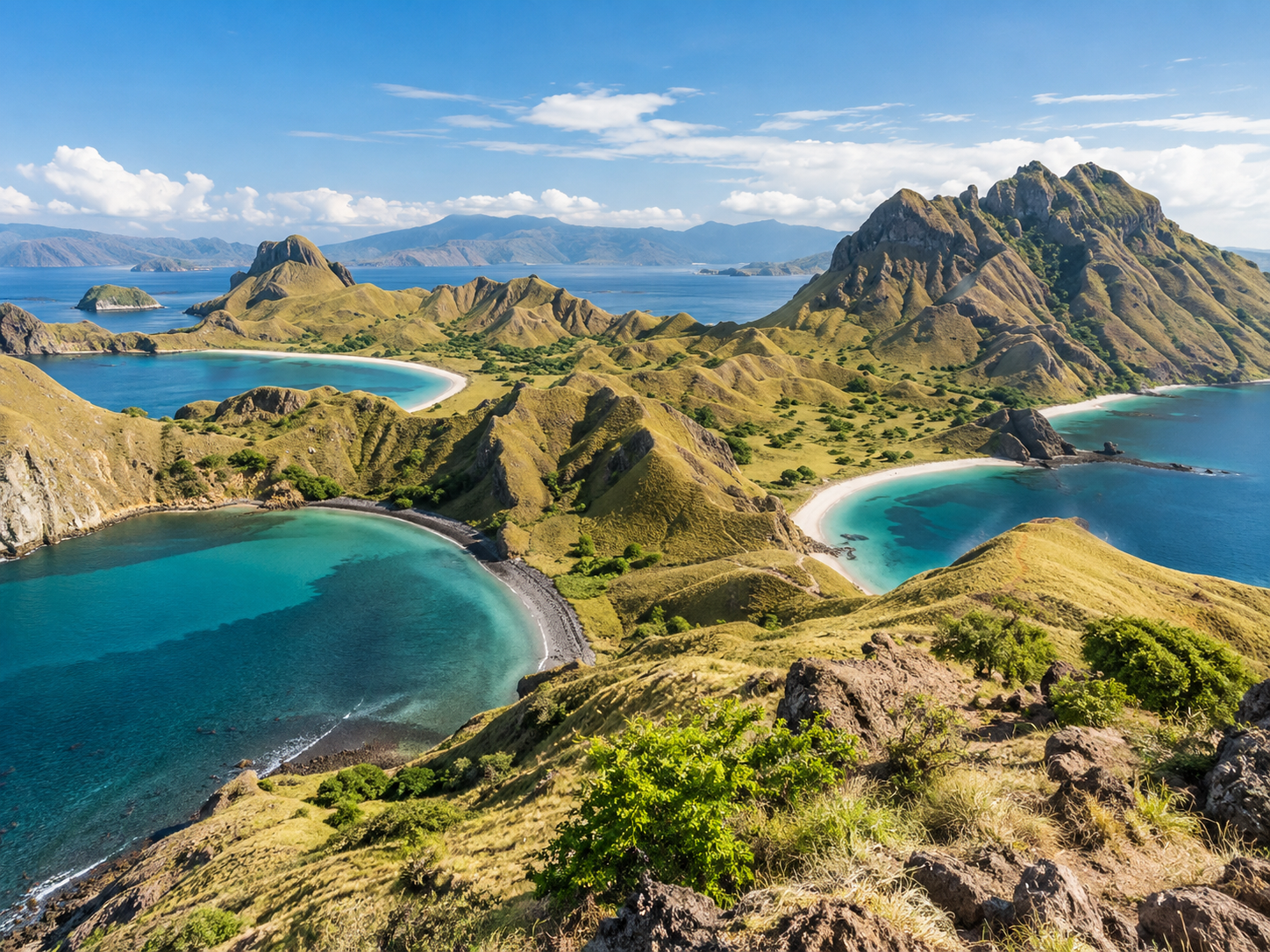
From the top of Padar, the archipelago becomes like a map: curved bays, dry hills and deep blue sea merge into one of Indonesia's most recognizable landscapes.
Komodo National Park
The main reason why the name Labuan Bajo became known to travelers is not due to the city itself.
This is Komodo National Park.
Its islands are best known for their Komodo dragons, but the park itself is much more than just one animal species.
These are dry savannas.
Rocky islands.
Coral reefs.
Mangrove areas.
Sea canals.
And a vast territory where land and sea constantly replace each other.
Observations of Komodo dragons are only possible when accompanied by rangers.
This is not an amusement park or a petting zoo.
In front of the traveler is a wild animal whose behavior cannot be fully predicted.
So the rangers' instructions are really important here.
Rinca and the other side of the park
Rinca Island is another important part of the national park.
It is often less known to those just starting to plan a trip, but it allows you to see a different character of the archipelago.
Here, dry savannah meets the coastline, and routes pass through areas where monitor lizards and other regional animals can be found.
You shouldn't try to compare islands solely on the principle of "which is better?"
Every place has its own rhythm and its own landscape.
It is the combination of these stops that gradually forms the impression of Komodo.
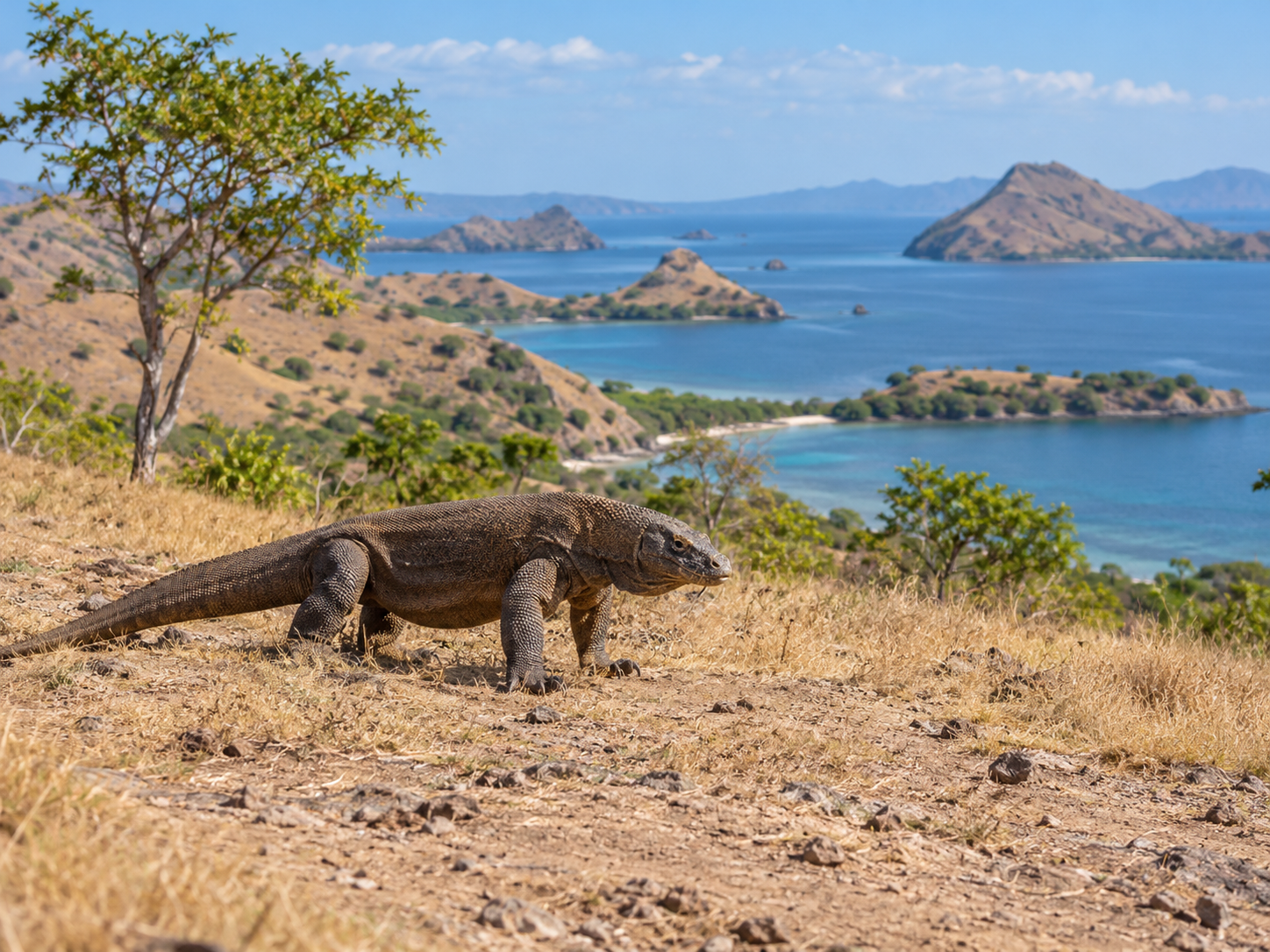
The islands' arid landscape appears almost harsh, and it is in this environment that Komodo dragons, one of the most unusual features of this archipelago, live.
The journey continues underwater
Much of the region is hidden beneath the sea surface.
The coral reefs around the islands make the trip interesting even for those not planning serious diving.
Sometimes a mask and snorkel are enough.
In good conditions, the water is so clear that the dark outlines of the reef are visible even from the boat.
After diving, corals, small fish and larger marine life appear.
Some spots are known for strong currents, so conditions cannot be judged solely by an apparently calm surface.
A good local operator will take into account the weather, currents, group experience and sea conditions.
This is especially important in a region where distances between islands appear small only on a map.

Underwater, the archipelago changes completely: dry islands remain above, while below begins a vibrant world of corals, currents, and marine life.
Night on a boat
One of the most memorable ways to see Komodo is to spend a night on a boat.
During the day the ship moves between the islands.
In the evening it becomes a temporary home.
The shore gradually gets darker.
Other boats turn on their lights.
The water becomes almost black.
And above the islands a sky appears that is difficult to see near a large city.
This format has a practical side.
Before booking, please check in advance the cabin type, meals, shower, electricity, safety equipment and group size.
Photos of a boat don't always tell the whole story.
That's why details become more important than a pretty picture in a catalogue.
Return to Labuan Bajo
After a few days on the water, the city feels different.
What seemed like an ordinary port street before the trip, upon returning feels almost like comfort.
Hot shower.
Cafe.
Normal bed.
Connection.
A slow walk along the embankment.
And dinner without the rocking under your feet.
Therefore, it is useful to leave at least one night in Labuan Bajo after the sea portion of the route.
Especially if you have a flight planned for the next day.
The sea and weather don't always follow a schedule, and a little extra time can save you from unnecessary stress.
Sunsets over western Flores
There comes a point when Labuan Bajo ceases to be just a logistical point.
It's evening.
The city is located in such a way that sunset often becomes a full part of the day.
The sun sets behind the islands.
Silhouettes of boats appear in the harbor.
The sky gradually changes from gold to pink and then to deep blue.
Some travelers look for viewpoints on the hills.
Others remain near the water.
And sometimes the best plan is to just pick a spot with an open horizon and go nowhere else.
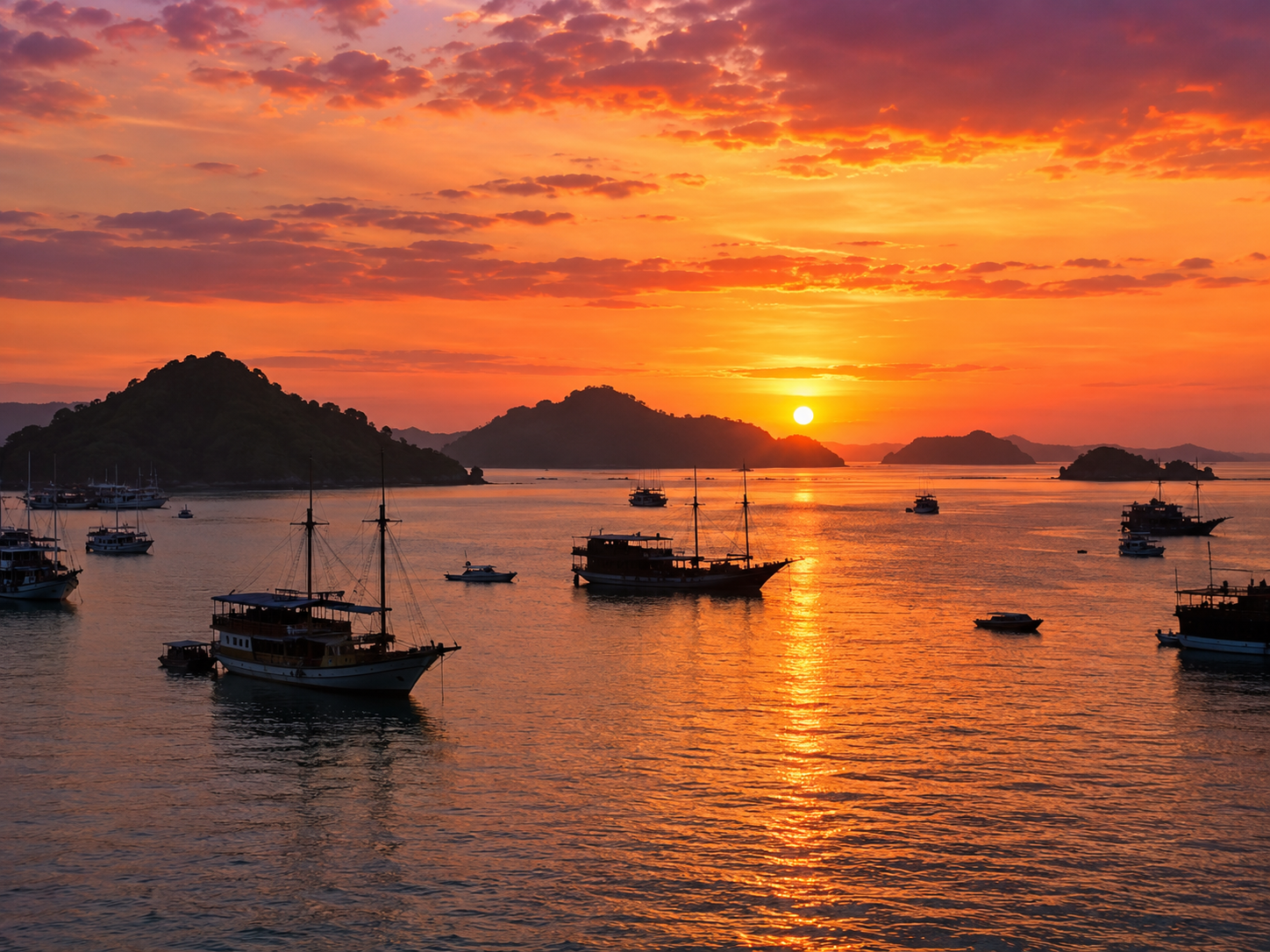
In the evening, the city seems to slow down: boats turn into dark silhouettes, islands dissolve in the sunset light, and the sea reflects the last minutes of the day.
How long to leave
If Labuan Bajo is used only as a starting point, it is easy to spend one night here before and one night after the trip.
But if you want to see the city in a more relaxed way, it’s better to leave an extra day.
It can be carried out without a complex program.
Take a walk along the water.
Look at the harbor.
Have seafood for lunch.
Climb to one of the observation points.
And just to recover after the eventful sea part of the route.
The main thing is not to try to turn every free hour into an excursion.
When is the best time to go?
The region can be visited at different times of the year, but the nature of the journey depends on rain, wind and sea conditions.
For boat routes, water conditions are especially important.
Even with clear skies, wind and waves can change the program.
Therefore, before a trip, it is useful to look not only at the general seasonal forecast, but also at the actual conditions immediately before departure.
During drier periods, island hopping routes are usually easier to plan.
But even then, weather remains a factor that cannot be completely ruled out.
Practical advice
Before taking a multi-day boat trip, check exactly what is included in the price.
Check accommodation, food, drinking water, snorkeling equipment and basic safety equipment.
Take sun protection.
Closed light clothing.
Comfortable shoes for climbing.
And a spare set of things in waterproof packaging.
If you have a flight planned after your boat trip, it's best not to schedule it too close to your return to port.
An extra night in Labuan Bajo often pays off over a tight schedule.
Not just a gateway to Komodo
It's easy to think of Labuan Bajo as just a place where boats depart.
But that's only part of his character.
It is remembered for the anticipation of the journey before setting out to sea.
Returning after several days among the islands.
Sunsets over the harbor.
The noise of boat engines in the morning.
And that special feeling when you look at the map and realize that a whole archipelago begins further ahead.
Perhaps that is why Labuan Bajo remains in the memory.
Not as one attraction.
And as a point between land and sea, from where one of the most unusual journeys in Indonesia begins.
Comments
Share your thoughts